Head motion is the whole behaviour
The 12 October 2026 post points at a small robot that looks attentive without arms or legs. That reading fits the hardware Pollen Robotics publishes. Reachy Mini is a desktop kit whose moving parts are a head, a turning body and two antennas. It is not a humanoid torso with a conventional stacked neck. [1] [2]
Reachy Mini shows how much personality a small robot can express through head movement alone. Its compact mechanical design lets it tilt and orient its head without a traditional neck.
Six legs hold the head
The datasheet assigns the head 6 degrees of freedom: three rotations and three translations. Those six motions come from a Stewart platform driven by six Dynamixel XL330-M288-T servos. A Stewart platform is a moving plate on six actuated struts. Changing the strut lengths translates and rotates the plate inside a limited workspace. There is no serial chain of neck joints to count. [3]
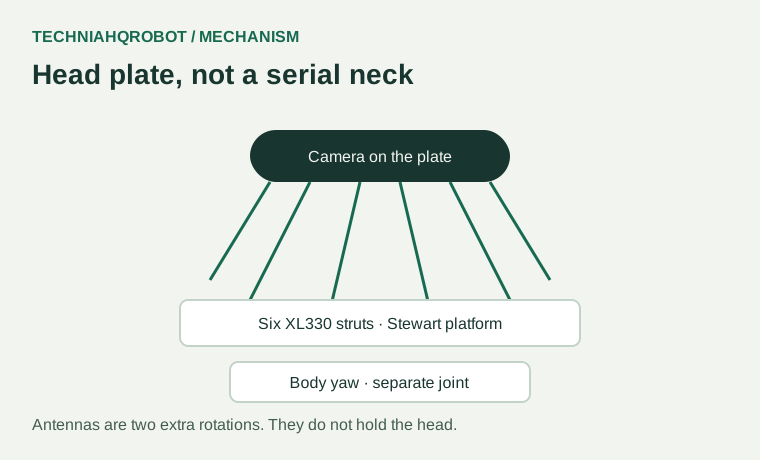
The body adds one rotation, through a custom Dynamixel XC330-M288-PG described as an XC330-M288-T with a plastic gear. Each antenna is one more rotation, using an XL330-M077-T. The antennas are visible expression. They do not support the head and they do not grasp. [3]
Parallel struts are stiff for their size and keep the mechanism short. They also couple every head motion: a pure nod still changes several strut lengths, and a command past the reachable set cannot be saved by adding a neck motor that is not there. The datasheet consulted for this article does not publish that reachable set in degrees. [3]
The camera moves with the plate
The head carries a Raspberry Pi Camera Module 3 wide-angle sensor: Sony IMX708, 12 megapixels, autofocus, listed at 120 degrees. Four PDM microphones, based on a Seeed reSpeaker XMOS XVF3800 board, sample at up to 16 kHz. A 5 W, 4 ohm speaker sits in the same body. When the plate tilts, the camera’s optical axis tilts with it. A behaviour that “looks at” a person is moving the sensor, not aiming a separate pan-tilt stage under a fixed camera. [3]
How a robot camera becomes a position is covered separately. How humanoid robots see
Lite and Wireless are not the same computer
The extended machine is listed at 30 × 20 × 15.5 cm and 1.475 kg, in ABS, polycarbonate, aluminium and steel. Power input is 6.8 to 7.6 V. The Wireless version carries a Raspberry Pi Compute Module 4, part CM4104016, with Wi-Fi, 4 GB of RAM and 16 GB of flash, plus a 2000 mAh LiFePO4 pack at 6.4 V, 12.8 Wh, with charge, discharge, current, short and temperature protection. The announcement’s Lite column has no onboard computer, no Wi-Fi and no battery. A host Mac or Linux machine supplies compute. [3] [2]
| Lite | Wireless | |
|---|---|---|
| Compute | Host computer | Raspberry Pi 4 class module |
| Power | Wired | Wired and battery |
| Head platform, body yaw, antennas | Yes | Yes |
| Announced price | $399 | $499 |
Both prices in that announcement exclude tax and shipping. They are launch figures, not a price checked at a store on 13 October 2026. The USB-C port on the Wireless controller board is an output. The datasheet says it does not charge the robot. [2] [3]
Expression here is not manipulation
Nothing in the datasheet is an arm, a gripper or a walking joint. A viewer who wants hands is looking at a different machine. The post’s question, expression or arms, is a product choice: this one publishes a head that can shift and turn, and stops there. Software on Hugging Face can play motions and run models. That stack does not add joints the plastic does not have. [3] [2]
Sources and verification
- Post on Reachy Mini head motion ↗TechniaHQRobot on X · Read 13 October 2026
Post text checked. The clip is the account’s footage of the robot. Joint trajectories were not digitized from the video.
- Reachy Mini announcement ↗Pollen Robotics · Read 13 October 2026
9 July 2025 product announcement. Lite and Wireless prices there exclude tax and shipping. Later reseller pages were not used as the current checkout price.
- Reachy Mini hardware datasheet ↗Pollen Robotics · Read 13 October 2026
Datasheet read for size, mass, degrees of freedom, motor names, camera, microphones, speaker, battery and the Wireless compute module.
Evidence limits
- The datasheet does not publish a measured workspace in degrees. Ranges quoted elsewhere were left out.
- The July 2025 announcement prices were not rechecked against a live store checkout.
- Head trajectories in the post’s clip were not digitized.
Article history
Added the Stewart-platform breakdown, the Lite and Wireless split, and the original post.
Report a correction