A small biped with the files attached
Open Duck Mini v2 is an open project led by Antoine Pirrone, aiming at a miniature of Disney’s BDX droid that a reader can actually build. The v2 README says the robot is about 42 cm tall with its legs extended, and that the full bill of materials should be under $400. Those two sentences are the hardware specification the project page itself is willing to print. [1] [2]
Open Duck Mini V2 is a 42 cm open-source robot duck with a parts budget under $400. Its walking controller is trained in MuJoCo and runs on a Raspberry Pi.
The same README calls the repository a working hub, with undocumented scripts, and says documentation is being written in pieces. The mechanical design is described as mostly settled, while expression parts (LEDs, a camera, a speaker and a microphone) can be added later. A walking duck in this repository is not yet the talking, looking character from the films. [1]
Training and the onboard computer are separate repositories
Walking policies are trained in simulation. The README says the project is moving that work to MuJoCo Playground and points to Open Duck Playground. Policies then run on a Raspberry Pi Zero 2W through Open Duck Mini Runtime, a third repository. CAD lives in an Onshape document, and the parts list is a spreadsheet linked from the README, with an English copy and a Chinese copy. [1] [3] [4]
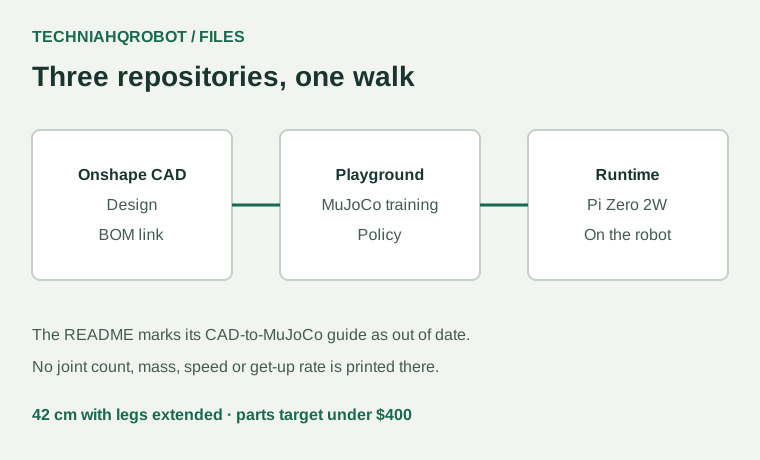
That split matters for anyone reproducing the walk. The training code is not the binary on the Pi, and the Onshape model is not a calibrated MuJoCo file. The README warns that its guide from Onshape to MuJoCo has not been kept current. Following it without checking the Playground repository is a good way to simulate a robot the hardware no longer matches. [1]
What this page will not invent
Secondary write-ups list servo models, a joint count and a mass. The v2 README does not. Repeating those numbers here would pretend the project page had published them. Until they appear in the repository or in a paper with a method, they stay off this article. The under-$400 line is likewise a target in the README, not an invoice checked part by part on 13 October 2026. [1]
Walking clips are not a get-up result
The README’s sim-to-real section points at videos of the physical duck, including a push, and at policies a reader can try. It does not report a success rate, a speed, a surface, or a trial count. It also does not describe a policy that stands the robot back up after a fall. A viewer comment that they had not seen a get-up is consistent with that silence. It is not a measurement either. [1] [2]
The Pi Zero 2W is a small computer for a neural policy. The project chose it so the controller travels inside the robot. That choice leaves little spare compute for a second model, a camera stream or a high-rate estimator. The README does not publish the policy’s inference time, so the margin is unknown. What is known is the division of labour: MuJoCo for training, the runtime repository for the robot. [4] [1]
How a simulated walk is supposed to be checked on hardware is covered here. Sim-to-real for humanoid robots
Sources and verification
- Open Duck Mini v2 repository README ↗Antoine Pirrone and contributors · Read 13 October 2026
README read in full. Height, bill-of-materials target, MuJoCo Playground, Raspberry Pi Zero 2W runtime, CAD and BOM links, and the stated gaps in expression hardware and documentation.
- Post on Open Duck Mini V2 ↗TechniaHQRobot on X · Read 13 October 2026
Post text checked. The README, not the clip, is the source for height, cost target and compute.
- Open Duck Playground ↗Antoine Pirrone and contributors · Read 13 October 2026
Linked from the v2 README as the MuJoCo Playground training stack.
- Open Duck Mini runtime ↗Antoine Pirrone and contributors · Read 13 October 2026
Linked from the v2 README as the code that runs policies on the onboard computer.
Evidence limits
- The linked bill of materials was not repriced line by line, so the under-$400 figure stays a project target.
- No joint count, mass or walking speed is stated in the README, so none is added here.
- Fall recovery is not reported. A comment under the post is not a trial log.
Article history
Added the repository’s own scope for hardware, training and the onboard computer, plus the original post.
Report a correction