Proprioceptive here means the motor current is the force sensor
Wensing and colleagues use “proprioceptive actuator” for a specific electromagnetic design, not for a neural model of the body. The MIT Cheetah leg keeps gear ratio low enough that the motor current is a usable stand-in for output force, and the actuator stays backdrivable so an impact does not break the drivetrain. They introduce an impact-mitigation factor to compare that backdrivability with designs that put a spring in series. The Cheetah leg’s factor is in the same range as those sprung quadrupeds, while the force control bandwidth stays high because there is no soft element to wait on. [1]
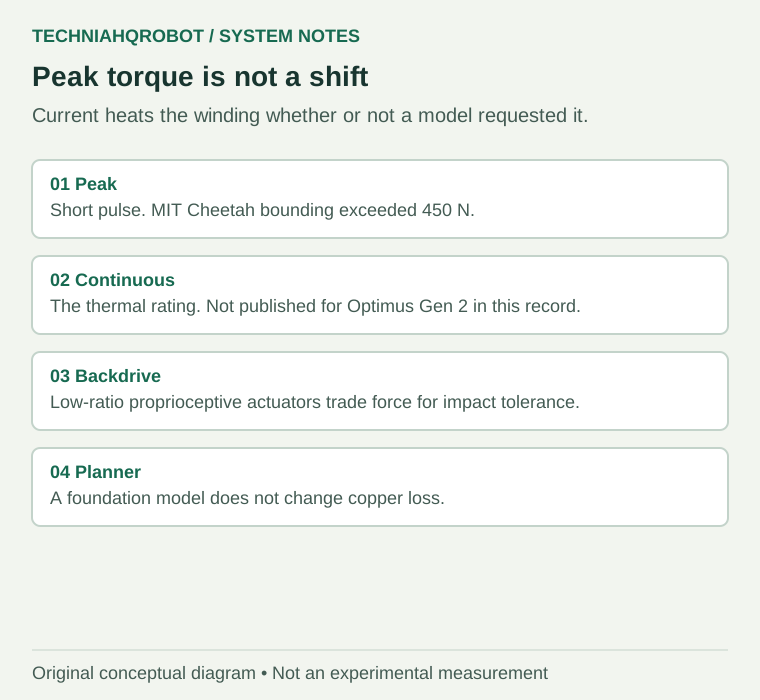
The dynamic numbers in that paper are easy to misuse. During bounding, contact times go down to 85 ms and peak forces go above 450 N. Those are peaks during a short contact on that robot. They are not a continuous load the motor can hold, and they are not a specification for any humanoid. The paper lists the ordinary design metrics that sit beside the peak: motor constant, torque constant, peak torque, continuous torque, thermal capacity. Naming continuous torque and thermal capacity is the point. The peak and the continuous rating are different numbers because copper loss heats the winding. [1]
A foundation model does not appear in that heat balance. It can request a joint torque. The winding turns the current into heat whether the request came from a model-predictive controller or from a language-conditioned policy. If the request is a string of peaks, the thermal limit arrives as a current foldback or a shutdown. The plan does not get to ignore the foldback. The foldback changes the force the plan thought it had. [1]
A shift is a thermal integral, not a peak in a video
Continuous torque is the torque the thermal design can hold without the winding temperature walking off. Peak torque is what the magnetic circuit and the driver can do for a short time. Wensing’s bounding peaks sit in the second category: large force, contact under a tenth of a second. A manipulation or a slow squat that holds a high torque for seconds sits in the first category. A model that only shows the peak, because the peak looks like strength, has not sized the task. [1]
Backdrivability cuts both ways. A low-ratio actuator that survives impact, which is the Cheetah result, gives up the free torque multiplication of a large gear. Force comes from motor current, so heat comes from motor current. A high-ratio actuator can produce the same output torque with less motor torque and therefore less copper loss, and then loses the impact behavior the paper is about. The trade is physical. A more capable planner does not move the gear ratio. [1]
Optimus Gen 2, in this record, does not publish the thermal number
The Optimus Gen 2 entry on this site is deliberately narrow. The verified description says Tesla-designed actuators and sensors, an articulated neck and revised hands, on the December 2023 prototype. Height, mass, battery time and degree-of-freedom count are marked not stated for that configuration. No continuous torque, no winding temperature, no gear ratio and no duty cycle are in that record. A launch video is not a dynamometer.
It is tempting to paste the Cheetah’s 450 N and 85 ms onto Optimus because both are legged machines with custom actuators. That paste is a false measurement. The Cheetah figure is a quadruped bounding contact. Optimus is a humanoid prototype whose actuator data were not in the source this catalogue accepted. Using one to fill the other hides the exact quantity a buyer or a controls engineer needs: continuous torque at a stated temperature, for the joint that will hold the load. [1]
The missing fields are already explicit. Optimus Gen 2 profileThis page does not invent values for them.
The foundation-model half of the pitch fails in the same place. A model can propose a 10-second manipulation. If the shoulder or the knee must hold a large torque for those 10 seconds, the limit is the continuous rating and the heat path out of the stator. No paper cited here shows that a language model changes that path. The honest illustration from Optimus is the absence: until a continuous curve is published, the model’s plan is an uncosted request.
Write the duty cycle in seconds, not in adjectives
A duty cycle is a sequence of torques and the seconds each torque is held. Wensing’s bounding contact, under 85 ms above 450 N at the foot, is one kind of line in that sequence: a brief peak. A humanoid holding a box with a bent elbow is another line: a smaller torque held for as long as the grasp lasts. The thermal mass of the winding averages the sequence. A planner that inserts extra corrective peaks, because its tracking error is large, adds lines the thermal design may not have included. The model’s loss function does not know the temperature. [1]
Current foldback is the actuator’s veto. When the driver reduces current to protect the winding, output torque falls even if the planner still requests the old value. On a proprioceptive design, where current is the force estimate, the fall is visible as a force error. On a high-ratio joint with a separate torque sensor the fall is also real, but the sensor and the heat sit in different places. Either way, the foundation model does not get the torque it requested. A log that records only the request, and not the current after foldback, will claim the plan was executed. [1]
Optimus does not become an exception because the actuators are custom. Custom means the ratio, the cooling, and the continuous curve could be different from the Cheetah. It does not mean they can be skipped. The Gen 2 catalogue entry already refuses to invent mass and torque. This page refuses the same invention. Until the continuous curve is public, the only supported statement is that a plan is not a thermal measurement, and that the Cheetah paper shows what a thermal-aware actuator paper looks like when the peaks are actually measured. [1]
The decision in a design review is then binary. Either the joint datasheet has continuous torque at a named temperature and a peak duration, and the task duty cycle fits under that curve with margin, or the task is not sized. A video of a robot lifting once does not choose the first branch. A language model that describes the lift does not choose it either. [1]
What a continuous-torque curve has to show
A single peak number is not a curve. A useful actuator note names the continuous torque after the temperature has stopped rising, the peak torque and how long it may be held, the speed at which continuous torque falls, and the thermal resistance that sets the wait. Wensing and colleagues treat those quantities as the design metrics of a proprioceptive actuator, because current stands in for torque only while the motor is inside that envelope.
A foundation model that outputs a joint target does not know this envelope unless a separate limiter enforces it. The limiter can clip the command, slow the motion, or refuse the grasp. Clipping is invisible in a highlight reel and obvious in a duty-cycle log. That is why a plant that runs the same motion for an hour is more informative than a plant that runs it once.
| Question | Why it matters |
|---|---|
| Continuous torque at the relevant speed | Sets the load you can hold after warmup. |
| Peak torque and allowed duration | Sets the short lift, not the shift. |
| Winding or case temperature at foldback | Shows that the limit is thermal, not a software cap with no sensor. |
| Gear ratio, or a statement that it is low | Tells you whether current still tracks torque and whether the joint can be backdriven. |
| What the controller does at the limit | Clip, slow, or stop. A model retry is not on this list. |
Until those rows are public for Optimus, the honest statement is the one already on the robot profile: custom actuators, and no continuous rating. The article does not fill the blank with a neighbouring humanoid's motor.
Ask for the curve the heat actually follows
| Quantity | MIT Cheetah paper | Optimus Gen 2 record on this site |
|---|---|---|
| Peak contact | Above 450 N, contacts down to 85 ms, in bounding. | Not stated. |
| Continuous torque and thermal capacity | Named as design metrics. A full thermal map is not copied here. | Not stated. |
| How force is sensed | Motor current, low gear ratio, backdrivable. | “Tesla-designed actuators,” no ratio. |
| What a foundation model changes | Not in the 2017 paper. | Not in the Gen 2 record. |
- Continuous torque at a stated winding or case temperature, for the joint that holds the task.
- The time the peak may be repeated before foldback, at the ambient temperature of the cell.
- Gear ratio, or an equivalent statement of reflected inertia, so impact and heat can be discussed together.
- A duty cycle taken from the task, not from a single video frame of a high torque.
If those four items exist, a model can be judged as a client of the actuator: how often it requests peaks, and whether the inner current loop is allowed to refuse them. If they do not exist, the model is not evidence of strength. The Cheetah paper is evidence that the distinction between peak and continuous was already the design problem in 2017, on a robot that did publish peaks. [1]
Sources and verification
- Proprioceptive Actuator Design in the MIT Cheetah ↗Patrick M. Wensing and colleagues, IEEE Transactions on Robotics · Read 12 October 2026
2017 TRO paper. Proprioceptive, low-impedance actuation. Bounding contacts down to 85 ms and peak forces over 450 N. Continuous torque and thermal capacity are named as design metrics. No Optimus data.
Evidence limits
- 450 N and 85 ms are MIT Cheetah bounding results, not Optimus measurements.
- The Optimus Gen 2 profile does not state continuous torque, mass or gear ratio.
- No winding temperature is inferred.
Article history
Added the MIT Cheetah proprioceptive-actuator measurements and kept Optimus Gen 2 limited to the fields already verified in the catalogue.
Report a correction