The short answer
A collaborative robot, often called a cobot, is a robot arm designed for applications where people and the robot share a workspace. Typical features are joint torque or force sensing, limits on speed and force, and configurable safety functions that stop or slow the arm. A gripper or other tool at the end of the arm, called the end effector, does the actual holding. [1] [2]
The word “collaborative” describes an application, not a robot. The 2025 revision of the US industrial robot safety standard, adapted from ISO 10218:2025, replaced the term “collaborative robot” with “collaborative application”, because the safety of collaboration depends on the whole application: the arm, the tool, the part, the speed, the layout and the people nearby. [3] [4]
A simple picture: carrying a tray through a busy kitchen
A waiter carrying a tray through a busy kitchen moves slowly near people, keeps the tray steady and stops if someone steps in front. A cook with a sharp knife works more carefully again. The same person is safer or riskier depending on what they carry and where they move.
A cobot is similar. An arm that is gentle enough to bump into someone while holding a foam block can be dangerous when holding a blade or a hot part. The comparison has a limit: the waiter notices danger by looking and thinking, while the robot only reacts to what its sensors and safety settings detect.
Cobot or traditional industrial robot?
| Traditional industrial arm | Arm used in a collaborative application | |
|---|---|---|
| Typical layout | Inside a guarded cell that people do not enter while it runs | Shared space, with people nearby or working with the arm |
| How people are protected | Fences, interlocked doors, light curtains | Hand guiding, speed and separation monitoring, power and force limiting, plus guards where needed |
| Force sensing | Not required for guarded operation | Joint torque sensors, a force/torque sensor or current-based estimates |
| What decides safety | The cell design and risk assessment | The application design and risk assessment |
The R15.06-2025 announcement names three collaborative technologies: hand-guiding controls, speed and separation monitoring, and power and force limiting. Power and force limiting is intended to keep contact forces and pressures low enough that an accidental contact does not injure a person, according to limits the application must justify. Speed and separation monitoring slows or stops the robot as a person approaches. [3] [5]
The distance calculation behind speed and separation monitoring is worked through in why an edge vision model cannot set the safe speed.
Inside a collaborative arm
Two documented examples show the common building blocks. Universal Robots lists six rotating joints, a 5 kg payload, an 850 mm reach and a built-in force/torque sensor with 4 N accuracy for the UR5e, along with 23 configurable safety functions rated PL d Category 3 under EN ISO 13849-1. Kinova offers its Gen3 with six or seven degrees of freedom, torque sensors integrated in each actuator, reaches of 891 mm and 902 mm, and support for ROS 2 Humble through its Kortex software. [1] [2]
Payload figures need reading carefully. Kinova lists 2.0 kg continuous across the full range and 4.0 kg in the middle of the range, both excluding the gripper. The gripper’s own mass, and the distance of the load from the wrist, come out of the payload budget. [2]
The motors, gearboxes and encoders inside these joints are described in how robot joints and actuators work.
Types of gripper
| Gripper | How it holds | Good for | Weak at |
|---|---|---|---|
| Parallel two-finger | Two fingers close and squeeze; friction or shape holds the part | Rigid parts with two parallel faces | Very soft, very large or irregular objects |
| Adaptive or underactuated fingers | Linked finger segments wrap around the object | Mixed shapes, encompassing grips | Precise placement of small parts |
| Multi-finger hand | Several jointed fingers place contacts individually | Varied objects and in-hand repositioning | Cost, complexity and control effort |
| Vacuum (suction) | Lower pressure inside a cup lets air pressure hold the object | Flat, smooth, non-porous surfaces such as boxes and sheets | Porous, rough, curved or dusty surfaces |
| Magnetic | A magnet holds ferromagnetic parts | Steel sheets and parts | Non-magnetic materials |
Robotiq’s 2F-85 is a concrete example of a two-finger gripper with adjustable behaviour: an 85 mm stroke, grip force adjustable from 20 to 235 N, closing speed from 20 to 150 mm/s, and support for both pinch and encompassing grips. [8]
The tool connects to the arm in two ways. A mechanical interface, usually a bolted flange at the wrist, carries the load. An electrical interface supplies power and signals, either through a tool connector on the arm or through separate cables. Both must match before a gripper can be used with a given arm.
Three objects, three grips
Holding a metal component with two fingers
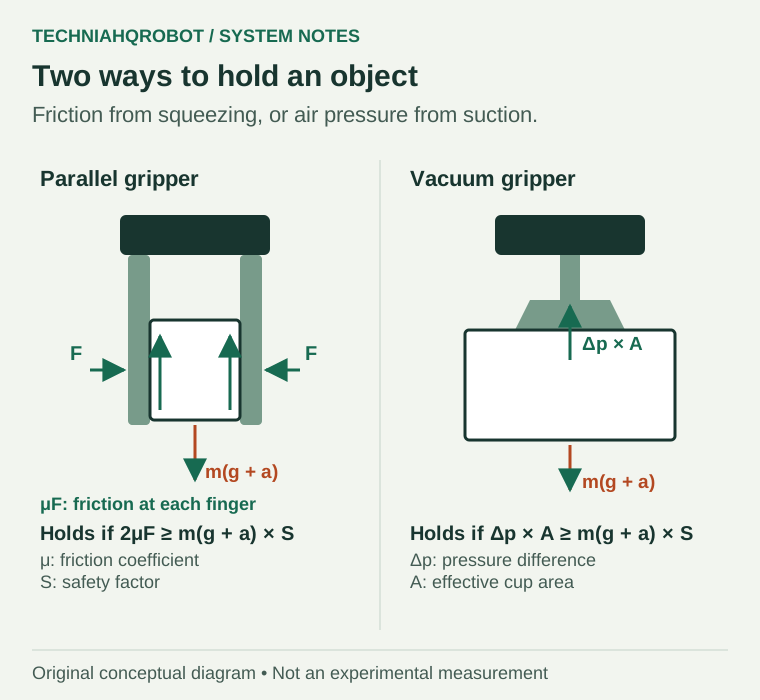
With a friction grip, the fingers press with force F, and friction between each finger and the part provides at most μ × F, where μ is the friction coefficient. Two fingers must hold the part’s weight plus the extra force needed to accelerate it, with a margin: 2μF ≥ m × (g + a) × S.
Picking a box with suction
A suction cup’s theoretical holding force is the pressure difference times the effective cup area, F = Δp × A. Schmalz recommends a safety factor of at least 2, notes that German accident-prevention rules prescribe 1.5, and advises 2.5 or more when a part is swiveled. [7]
Handling something that breaks easily
A paper cup, a ripe fruit or a thin plastic part can be crushed by the force needed for a secure friction grip. Options include closing slowly with a low force limit, using soft pads or fingers that wrap around the object, holding it by its shape instead of by squeezing, or switching to suction on a smooth face. Tactile sensing can help the robot notice slip before squeezing harder. [8] [9]
How robots detect slip and choose contacts is explained in how humanoid robots pick up objects.
How the arm and gripper work together
A pick is a coordinated sequence. The arm moves the open gripper to a pre-grasp pose above the object, approaches slowly, and the gripper closes. The gripper reports that it has stopped closing, which suggests contact, or a vacuum sensor reports that pressure has dropped. A wrist force/torque sensor or joint torque sensors measure the added weight when the arm lifts. If the measured load is wrong, the controller treats the pick as failed. [6] [1]
Force sensing also protects people. Collision detection compares expected joint torques with measured ones; a sudden unexplained difference means the arm has hit something, and the configured reaction is to stop or move back. How hard the arm may press before reacting is part of the power and force limiting settings that the application’s risk assessment must justify. [4] [3]
Risk assessment and shared workspaces
Every application needs its own risk assessment. The general method is set out in ISO 12100, and the robot-specific requirements in ISO 10218-1 and ISO 10218-2, which were revised in 2025; Part 2 now incorporates collaborative application content drawn from ISO/TS 15066. In the EU, a Commission decision published in September 2026 lists EN ISO 10218-1:2025 and EN ISO 10218-2:2025 under the Machinery Directive; in the US, they are adopted as ANSI/A3 R15.06-2025. Check which edition applies in your jurisdiction and for your application. [10] [4] [11] [3]
| Hazard in a shared workspace | Example | Typical control |
|---|---|---|
| Tool hazard | A sharp edge, a hot part or a blade in the gripper | Guarding, lower speed, or no collaboration for that step |
| Clamping | A hand trapped between the arm and a table or fixture | Layout with clearance, force limits, reduced speed near fixtures |
| Dropped load | A part slipping from the gripper or suction lost | Grip checks, safety factors, keeping paths away from people |
| Unexpected restart | The arm moving while someone is inside its reach | Clear status signals and protected restart procedures |
| Human approach | A person walking into the arm’s path | Speed and separation monitoring with area scanners |
What a safety certificate does and does not cover is explained in humanoid robot safety standards and certification.
Sources and verification
- UR5e technical specifications ↗Universal Robots · Read 15 October 2026
Manual page read for 5 kg payload, 850 mm reach, six rotating joints with ±360° range, 180°/s maximum joint speed, ±0.03 mm pose repeatability per ISO 9283, 4 N force/torque sensor accuracy, 20.7 kg arm mass and 23 configurable safety functions rated PL d Category 3 under EN ISO 13849-1.
- Kinova Gen3 ultra lightweight robot one-pager (2026) ↗Kinova · Read 15 October 2026
Manufacturer sheet read for 6-DoF and 7-DoF versions, 2.0 kg full-range and 4.0 kg mid-range continuous payload excluding the gripper, 891 mm and 902 mm reach, 7.2 kg and 8.2 kg mass, smart actuators with integrated torque sensors, an optional vision module, Kortex software with ROS Noetic and ROS 2 Humble support, 36 W average power and 50 cm/s maximum Cartesian speed. No repeatability figure is given.
- ANSI and A3 publish revised R15.06 industrial robot safety standard ↗Association for Advancing Automation (10 September 2025) · Read 15 October 2026
Announcement read for R15.06-2025 adapted from ISO 10218-1:2025 and ISO 10218-2:2025, replacement of the term collaborative robot by collaborative application, inclusion of ISO/TS 15066 content in Part 2, and the three named collaborative technologies: hand guiding, speed and separation monitoring, and power and force limiting. US adoption; the ISO documents apply internationally.
- ISO 10218-1:2025 preview, industrial robot safety requirements ↗ISO, preview via ANSI webstore · Read 12 October 2026
Third edition, February 2025. Preview states that collaborative operation is a property of the application, not a robot brand, and lists safety functions including stopping-time and stopping-distance limiting. The preview is not the full paid standard.
- Implementing Speed and Separation Monitoring in Collaborative Robot Workcells ↗Jeremy Marvel and colleagues, NIST, Robotics and Computer-Integrated Manufacturing · Read 12 October 2026
Public account of the ISO/TS 15066 protective-separation formula. Human motion during reaction plus stop, robot motion during reaction, stopping distance, intrusion, and position uncertainty. Stopping time depends on speed and load.
- Robotic Manipulation chapter on robot hardware ↗Russ Tedrake, MIT · Read 8 October 2026
Position and torque control, transmissions, parallel grippers and underactuated fingers.
- Design of the suction cup ↗J. Schmalz GmbH · Read 15 October 2026
Manufacturer guidance read for theoretical holding force F = Δp × A, a recommended safety factor of at least 2, the 1.5 factor prescribed by the German UVV accident prevention regulation, 2.5 or more when swiveling workpieces, friction coefficients determined by trials, and suction trials for porous parts.
- Robotiq 2F-85 and 2F-140 adaptive gripper product sheet ↗Robotiq · Read 15 October 2026
Product sheet read for the 2F-85: 85 mm adjustable stroke, 20 to 235 N adjustable grip force, 5 kg form-fit and friction payloads, 20 to 150 mm/s closing speed, 0.9 kg mass and 0.4 mm fingertip position resolution. The sheet points to support.robotiq.com for official figures.
- Maintaining Grasps within Slipping Bound by Monitoring Incipient Slip ↗Siyuan Dong, Daolin Ma, Elliott Donlon and Alberto Rodriguez, MIT · Read 8 October 2026
2018 manuscript. ABB-1600 arm and WSG-50 gripper. Slip detection accuracy is separate from pickup success.
- ISO 12100:2010 scope and revision status ↗ISO · Read 8 October 2026
Published, confirmed in 2022 and marked for revision at the check date.
- Machinery harmonisation Decision (EU) 2026/2015 ↗European Commission / EUR-Lex · Read 8 October 2026
Published 7 September 2026; references EN ISO 10218-1:2025 and EN ISO 10218-2:2025 under the Machinery Directive.
Article history
First version, written after a site audit found no page on collaborative applications, gripper types or end-effector selection.
Report a correction