What is the University of Tokyo robotic face?
The University of Tokyo’s JSK research record describes a facial robot designed around muscles, skeletal support and skin. The research direction treats expression as a physical deformation problem. A rigid structure establishes attachment geometry, while compliant structures transmit motion across the face. The university also lists earlier work on printed soft facial structures. [Source ↗] [Source ↗]
The 2026 paper listed for IEEE-RAS Humanoids is by Shun Kaneko, Shunnosuke Yoshimura, Akihiro Miki, Kento Kawaharazuka and Kei Okada. It evaluates basic facial motion in a musculoskeletal skin system. The publication listing confirms the subject and authors, but does not supply the complete experimental data. [2]
Original project URL supplied with the editorial material: Research project page. Access could not be confirmed during review.
Hardware specifications and evidence status
| Parameter | Available information | Evidence status |
|---|---|---|
| Research team | University of Tokyo JSK; five listed authors | Confirmed publication records |
| Mechanical concept | Musculoskeletal structure with skin | Confirmed research title |
| Artificial muscle types | 34 | Editorial video title; unverified count |
| Muscle fabrication | Flexible TPU, 3D anatomical design | Earlier editorial notes; unverified |
| Transmission | Internal wire pulled to shorten structure | Earlier editorial notes; unverified |
| Outer skin | Silicone | Earlier editorial notes; unverified |
| Actuation in reported tests | Manual | Earlier editorial notes; unverified |
| Independent actuator channels | Unknown | Full experimental record unavailable |
| Force, travel, speed and lifetime | Unknown | No verified measurements available |
| Mass, dimensions, power and price | Unknown | No verified specification available |
| CAD, BOM and software license | Unknown | No verified release available |
[Source ↗] [2] [Source ↗]
A count of muscle designs is different from a count of physical muscle pieces, motor channels or controllable degrees of freedom. Do not use 34 as the number of actuators without a wiring or actuation map. A facial mechanism may share a cable across regions or couple multiple pieces mechanically.
How artificial facial muscles could move the skin
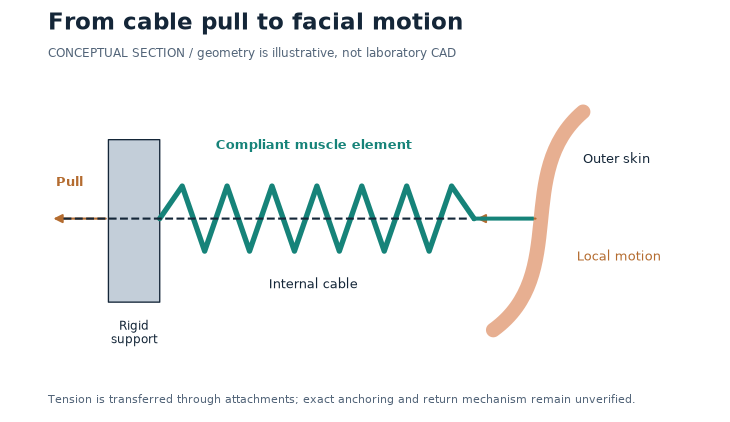
The reported mechanism can be understood as a tensile load path. A cable applies tension to a deformable element anchored against a support. The element changes shape and transfers a portion of the motion to adjacent tissues or an attached skin. When tension is reduced, elastic recovery may return the structure toward its neutral shape. The actual return mechanism and anchoring geometry remain unverified for this prototype.
Why use a compliant material?
Thermoplastic polyurethane (TPU) can bend and stretch in ways that rigid linkages cannot. The shape of a printed part, its wall thickness and the printing direction can change its stiffness. These are engineering properties of the proposed mechanism, not published settings for the Tokyo prototype. A designer must match the displacement direction, cable routing and elastic recovery to the motion of the target facial region.
What changes when the skin is attached?
A skin layer transfers force across neighboring attachment points. Pulling one cable can change several facial landmarks together. A human facial strain study found that local stretching and compression can coexist during facial actions, illustrating why matching the external shape alone is insufficient. A robot needs a mechanical arrangement that distributes those strains. [Source ↗]
Facial Action Coding System and reported movement coverage
Facial Action Coding System (FACS) describes observable facial movements as action units (AUs). For example, AU1 is an inner brow raise, AU12 is a lip corner pull, AU26 is a jaw drop and AU43 describes closed eyes. Several movements may combine into one expression. An action unit count is neither an emotion recognition accuracy nor a repeatability measurement. Nikola provides an example of a robot evaluated with this vocabulary. [3]
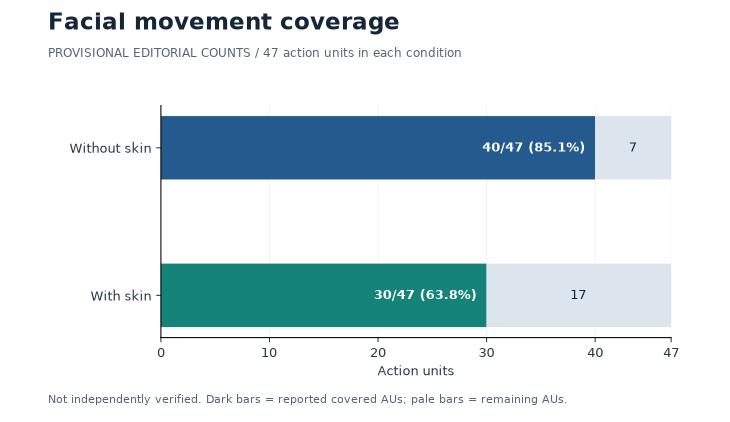
| Reported configuration | Covered AUs | Share of 47 | Not covered |
|---|---|---|---|
| Without skin | 40 | 85.1% | 7 |
| With skin | 30 | 63.8% | 17 |
| Difference | −10 | −21.3 percentage points | +10 |
If the same 47 movements were assessed with the same scoring rules in both configurations, the reported reduction would be 10 action units, or 25% of the original count of 40. The missing experimental protocol prevents a conclusion about whether individual movements failed because of skin stiffness, attachment geometry, scoring visibility or another cause.
Engineering model: cable displacement and force
A first approximation for a single pulling channel is F = kx, where F is force in newtons, k is an effective stiffness in N/mm, and x is displacement in millimetres. For a hypothetical motor spool of radius r, cable travel is approximately rθ and ideal motor torque is Fr, using metres for r and radians for θ. Friction, cable slack, skin coupling and geometric changes are excluded.
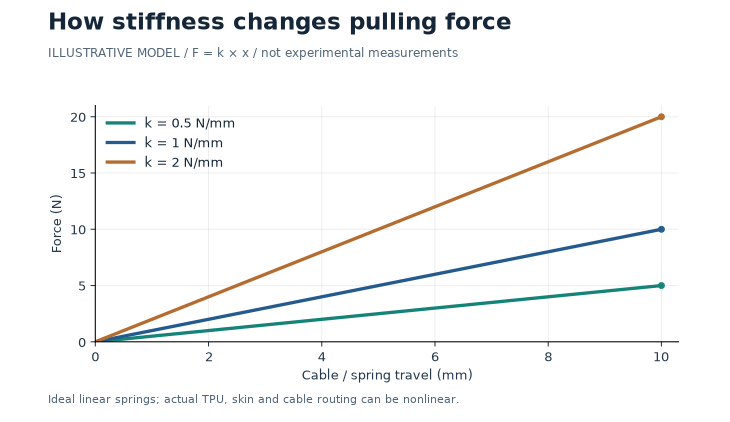
| Example travel | k = 0.5 N/mm | k = 1 N/mm | k = 2 N/mm |
|---|---|---|---|
| 2 mm | 1 N | 2 N | 4 N |
| 5 mm | 2.5 N | 5 N | 10 N |
| 10 mm | 5 N | 10 N | 20 N |
In real hardware, loading and unloading may trace different paths due to material hysteresis and routing friction. A useful experiment would record both directions, holding intervals and repeated cycles. That would reveal force loss, slow recovery and residual displacement. Those measurements are required before choosing motor size or setting safe cable tension.
From manual movements to a motorized Physical AI face
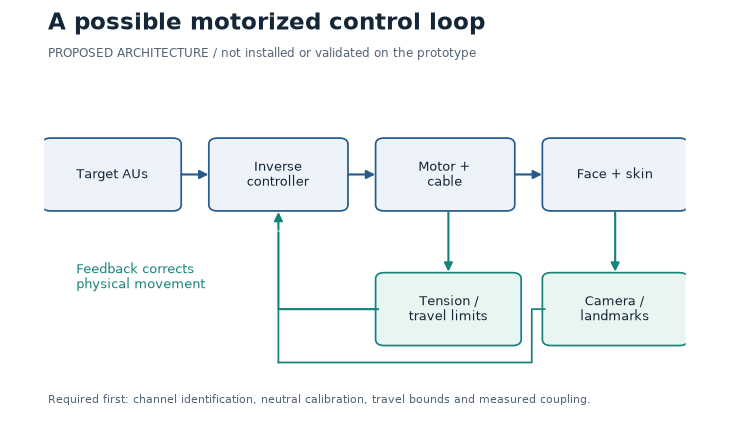
A motorized version would need an actuator map, cable travel limits and a neutral reference for each channel. A controller could convert desired AUs into target movements of facial landmarks, estimate the cable commands that produce them and use camera feedback to correct the result. Force or tension sensing would help constrain commands when motion is obstructed. This is a proposed design path.
Where AI could fit
A learned model could estimate the mapping from cable commands to observed facial geometry, including interactions between neighboring channels. An inverse model could then choose commands for a desired expression. Calibration data would need to include simultaneous muscle activation, skin-on measurements and different loading histories. There is no verified AI training method, autonomous expression policy or installed sensor suite for this face.
Speech and interaction
A conversational humanoid would need separate speech timing and facial control. Viseme targets describe mouth shapes associated with speech sounds. An expression scheduler would have to coordinate those targets with brow, eyelid and cheek motion while respecting physical limits. The current research record does not establish synchronized speech or real-time conversation.
How it compares with other expressive robot heads
| Research platform | Published hardware or approach | Scope of evidence |
|---|---|---|
| Tokyo musculoskeletal face (2026) | Musculoskeletal and skin structures | Research listing; detailed figures pending |
| Eva (HardwareX, 2021 issue) | 25 servo-driven muscles in total, including 12 facial; up to 15 mm skin travel | Open hardware publication |
| Nikola (RIKEN research) | 35 actuators overall: 29 facial, 3 head, 3 eye; 17 previously validated AUs | Published actuator breakdown and AU validation |
| University of Tokyo living-skin work (2024) | Cultured skin attached to a robotic structure | Separate project, not the TPU/silicone face |
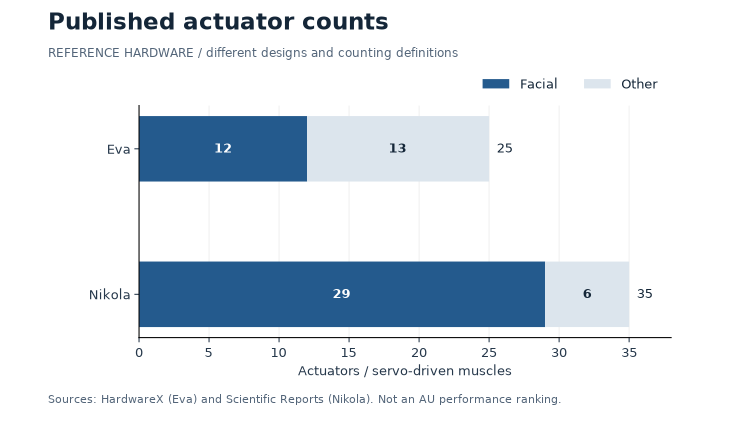
The Eva hardware paper lists an original hardware cost of $900 and a BSD 3-Clause license. This is a historical reference for an alternative research platform, not a quote for the Tokyo system or a current purchasing price. No verified Tokyo purchase price or parts list was found. [1]
How engineers should evaluate a robotic face
| Test | Method | Useful measurement |
|---|---|---|
| Single-channel calibration | Sweep cable commands in both directions | Travel (mm), tension (N), hysteresis |
| Facial motion coverage | Use a fixed camera and the same AU criteria with and without skin | AU IDs and pass counts |
| Coupled motion | Activate pairs and groups of cables | Landmark displacement and unwanted motion |
| Repeatability | Return to neutral between repeated commands | Mean error and spread (mm) |
| Timing | Track a step or periodic command | Rise time, settling time, phase lag |
| Fatigue | Repeat motion and inspect the same parts | Cycles, damage and change in displacement |
| Interaction | Run a consented, blinded expression-recognition study | Confusion matrix and participant variability |
A practical evaluation begins with skin-free calibration, then repeats it after the skin is installed. Use identical camera position, lighting, command limits and neutral geometry. Log both the command and its physical outcome. Distinguish movement that exists but is too small to satisfy a visual scoring rule from a mechanical failure to generate movement.
Possible applications and integration limits
A compliant face is a possible research component for social humanoids, animatronics and studies of human–robot interaction. It could also support experimental work on artificial tissue mechanics. None of those applications establishes a deployed product. For an industrial humanoid, adding an expressive head would also introduce packaging, cleaning, durability and service requirements that a simpler head may avoid.
A head designed for use around people would need guarded pinch points, bounded cable tension, an accessible stop and safe behavior after power loss. Maintenance would include inspection of printed elastic structures, cables and skin attachment points. These are suggested engineering requirements, not certified features.
Frequently asked questions
Is this an autonomous humanoid robot?
The confirmed record is a facial robot study. Autonomous facial control and whole-body humanoid integration have not been verified.
Does it have 34 motors?
No motor count is established. The editorial title refers to muscle types, which is a different quantity.
Did the robot achieve 85% expression accuracy?
That percentage is the arithmetic share of 40 out of 47 reported action units, if the editorial count is correct. It does not establish expression accuracy or emotion recognition.
Is the skin alive?
The silicone description comes from earlier editorial notes. Tokyo’s 2024 cultured-skin work is a different research project. [Source ↗]
Can I buy or build this exact robotic face?
No verified retail listing, price, CAD release, complete bill of materials or software license was found. The Eva paper is a documented open-hardware reference for a different face. [1]
What is needed to verify the results?
The original full paper, individual AU outcomes, materials and construction specifications, and the original actuation protocol. Until these are accessible, the project-specific numbers in this article remain provisional.
Sources and verification
- Facially expressive humanoid robotic faceHardwareX · Read 24 November 2026
Open hardware paper documenting Eva, its servo-driven face and original hardware cost.
- Kento Kawaharazuka: publication recordKento Kawaharazuka · Read 24 November 2026
Lists the five-author face robot paper under Humanoids 2026. The full paper was unavailable during this review.
- An android can show the facial expressions of complex emotionsScientific Reports · Read 24 November 2026
Describes Nikola’s actuator arrangement and previously validated facial action units.
Evidence limits
- Verify the original research page and paper before approving project-specific numerical claims.
- Confirm whether 34 refers to types, physical parts or another definition.
- Confirm the 47-AU denominator and the skin-on and skin-off scoring procedure.
- Determine actuator layout, materials, force limits, response speed, fatigue and code availability.
Article history
Prepared a research article with publication records, supplied video, conditional AU calculations, original engineering illustrations and an explicit evidence review.