Two hand targets leave a body to coordinate
OCLO learns body support without human motion recordings. A geometric reachability prior supplies pelvis height and torso tilt. Optional sampling tests candidate postures with the trained controller. Operators set hand poses through two controllers and walking velocity through the G1 joystick. [1]
Picture a robot reaching for a box on a low shelf. The two hand positions tell it where contact should occur. They leave several choices open. It could bend its knees, lean its torso, extend its elbows, or combine those movements. A reachable point is only one condition for a useful grasp. The feet must still support the body while the arms approach and the load changes.
That control split matters when watching the tasks. Selecting a box, deciding to turn and placing the next hand target remain operator decisions. Automatic posture adjustment reduces how many body coordinates the operator must supply. It does not, by itself, identify a suitable object or plan a complete job.
The study is a preprint dated October 5, 2026 by Seungho Yeom and colleagues. Its title refers to the absence of human motion data during training. [2]
Why a low box changes the pelvis and torso
The prior lowers the pelvis for low targets and pitches the torso for low or forward targets. A spring-damper model shifts hand references under force; inverse kinematics drives the arms. Proximal policy optimization (PPO) trains the legs and waist through walking, loaded reaching, then crouching and leaning in simulation. [1]
The project gives 0.07 ms for the geometric prior and evaluates 64 candidate postures during optional cross-entropy method (CEM) refinement, a sampling search. The real manipulation sequences use the prior alone. [1]
In the shelf example, knee flexion can lower the shoulders without demanding the same downward reach from the arms. A forward torso angle can bring the shoulders closer to the box. Those changes alter the arm configuration needed for the same hand positions. The target should stay attached to the shelf geometry while the body moves. Otherwise a downward-moving target could cancel the benefit of crouching.
This is a mechanical explanation of the example, not an additional OCLO experiment. Lowering the body can reduce some reach demands while increasing knee torque. Leaning moves body mass and changes the moment that the feet must resist. A posture can satisfy arm geometry and still be difficult to hold. That is why checking the motion through a controller adds information beyond a reach calculation.
The policy reads five observation frames, including proprioception, commands, force estimates and impedance parameters. It outputs targets for 12 leg and three waist joints; 14 arm joints use inverse kinematics. [2]
Here, proprioception means measurements of the robot itself, such as joint state. A control policy maps observations to commands. Sampling with that policy means running possible posture choices forward and inspecting the resulting motion. A task-agnostic cost scores generic requirements such as stability, tracking and effort. It contains no reward that says a particular box has been placed correctly.
The linked catalogue profile describes the commercial G1 base model, with 23 joint freedoms and no secondary development support. [3]
OCLO controls 29 body joints. Its research configuration differs from that base profile. [2] [3]
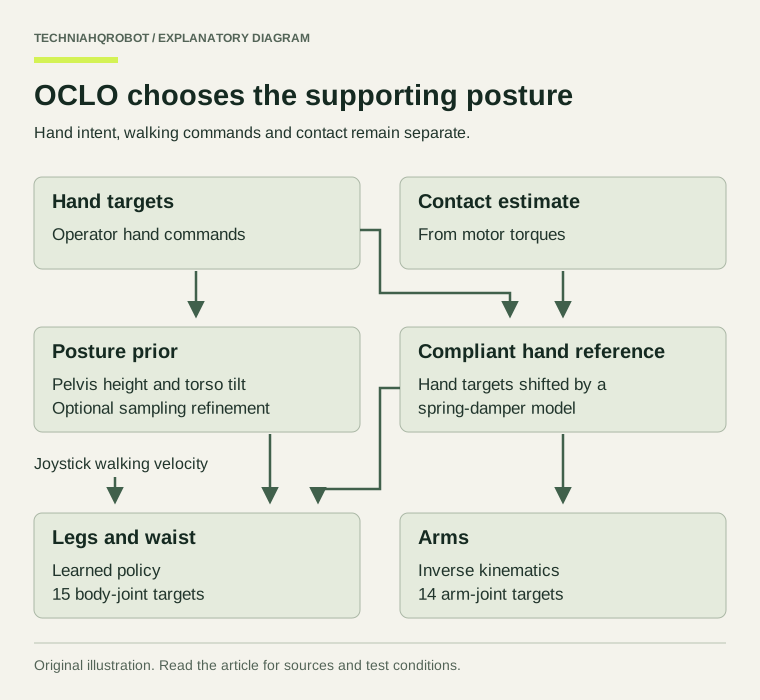
A hand can yield while the body stays supported
Imagine someone pulling one wrist. A rigid position request asks the motors to fight the displacement. A virtual spring permits displacement while producing a restoring response; damping opposes oscillation. The reference can move under the load, and the body must follow without losing support. This is software-defined compliance. It does not require a physical spring at every joint.
The useful distinction is between the requested hand target, the force-adjusted reference and the measured hand position. Error against each answers a different question. A robot can follow its adjusted reference accurately while moving away from the initial target. Reporting only one error can hide that trade-off.
A stronger restoring response may reduce displacement while passing more load into the body. More yielding can help maintain balance but allow an object to move. For a wipe, some yielding may be acceptable. For placing a part into a narrow opening, both the displacement and the contact force need measurement. These are engineering considerations, not tested payload guarantees for OCLO.
Read 77.8 percent with its actual comparison
Table III uses 90 paired episodes per cell, lasting 12 seconds after a one-second warm-up. Success requires staying upright, acquiring the reference within four seconds and maintaining tracking. The numeric tracking threshold is not specified. [2]
| Posture method | Success | Hand orientation error |
|---|---|---|
| CEM alone | 37.8% | 10.3° |
| Prior alone | 82.2% | 17.6° |
| Prior + CEM | 77.8% | 11.5° |
The 77.8 versus 37.8 comparison is a 40 percentage-point difference. Refinement also falls 4.4 points below the prior alone while reducing orientation error. A single success percentage therefore cannot describe every aspect of the motion. Acquiring a reference on time and aligning a hand precisely are separate performance questions.
For a low shelf, a search starting near a useful crouch has a different initial problem from one starting upright. Once the hand can reach the shelf, changing the torso angle can still alter wrist alignment. The table supports examining both outcomes. It does not supply a success rate for collecting arbitrary boxes in a workplace.
B1 removes target and force sampling; B2 removes force sampling. Under simulated Base Push, success is 13.3%, 23.3% and 62.2% for B1, B2 and Prior + CEM respectively. [2]
What happened on the physical G1
The project reports 10/10 successful frontal hand pulls at 20–40 N for Prior, versus 1/10 for B1 and 5/10 for B2. Prior also passes 10/10 at 50–70 N. Pulls use a force gauge; pushes are manual. The seven manipulation tasks use Prior alone. [1]
Those ten-trial groups show a difference within the stated setup. They cannot establish a safe working load. Pull direction, contact location, duration and initial posture all affect the moment transmitted to the feet. A force applied at one wrist is also a different load case from carrying a mass with both hands.
The seven qualitative tasks cover crouched walking, curtain opening, sink cleaning, chair pushing, cart pulling, board drawing/wiping and box pick-and-place. [2]
The task sequences are useful examples of changing body configuration during contact. A reliability study would also report attempted runs, interruptions, object dimensions, task duration and recovery after a failed grasp. A completed sequence alone supplies no denominator for a success percentage. The box sequence should therefore remain separate from the simulated Track result.
What an implementation still needs to check
Force comes from motor-torque estimates. Refinement uses off-board computing; hardware refinement tests keep targets fixed. One operator performed the hardware evaluation. [2]
Reproduction needs enough detail to distinguish controller behaviour from evaluation choices. The missing numeric tracking threshold affects what counts as simulated success. Trial-level force traces would show whether two pulls had comparable duration and direction. Tests with several operators would expose dependence on how hand targets are issued. Moving-target tests would check whether posture refinement can keep pace with a continuing reach.
A practical implementation also needs a response to bad force estimates, communication delay and joint limits. Those checks follow from the control architecture; they are not failures claimed by this article. The published evidence supports controlled tracking and contact experiments. It leaves payload limits, long-duration task reliability and autonomous task selection for further evaluation.
Watch the authors' task sequences and controller comparisons [1]
Sources and verification
- OCLO project and task videos ↗OCLO authors · Read 10 October 2026
Includes the walking joystick, training stages and physical trial table. Page metadata still describes an anonymous submission.
- Dataset-Free Compliant Humanoid Loco-Manipulation with Dynamic Online Posture ↗Seungho Yeom and colleagues · Read 10 October 2026
Preprint v1. Full nine-page PDF, figures and tables checked. No appendix follows the references.
- Unitree G1 and G1 EDU configuration table ↗Unitree Robotics · Read 10 October 2026
Commercial base G1 has 23 joint freedoms. Separate the catalogue version from the 29 controlled body joints in the OCLO paper.
Article history
Added a source-checked account of posture generation, compliance, simulation comparisons and physical G1 evaluation.
Report a correction