The short answer
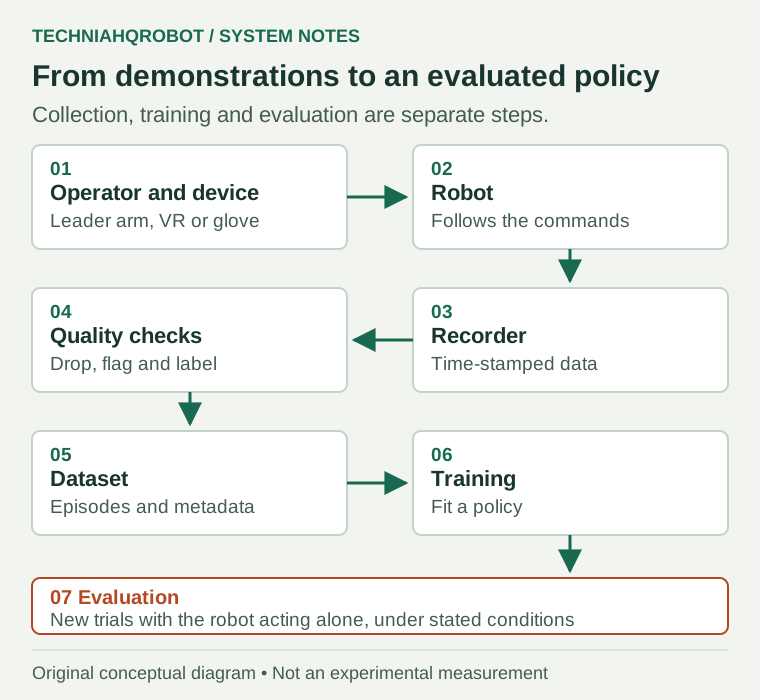
A common way to get robot learning data is to have people show the robot what to do. An operator controls the robot through a teleoperation device while software records what the robot saw and felt, and what it was told to do, at every moment. Those recordings, called demonstrations or episodes, are checked, labelled and stored, then used to train a policy: a program that maps new observations to actions. [1] [2]
Collecting demonstrations is not the same as getting a robot that works. The trained policy still has to be tested, on its own, in conditions it was not trained on. Many policies that look good on their training data fail when an object, a camera angle or a room changes. [3] [4]
A simple picture: teaching by guiding a hand
Think of teaching a child to write a letter by holding their hand and moving the pen together. After many repetitions the child can do it alone. Robot demonstration learning works in a similar way: a person guides the robot through a task many times, and a model learns to repeat the pattern.
The recording works like a flight recorder that logs every camera frame, every joint angle and every command with a precise time. Later, the training program looks at pairs of “what the robot observed” and “what the operator did next”.
The analogy has an important limit. A child understands what a letter is for. A policy learns statistical links between what it saw and what was done. If the cup in front of it looks different from every cup in the recordings, it has no understanding to fall back on. [3]
What one demonstration contains
| Data | Examples | Why it is recorded |
|---|---|---|
| Images | RGB video from fixed and wrist-mounted cameras | What the robot will see when it runs the task alone |
| Depth | Stereo or depth-camera images | Distances to objects and surfaces |
| Robot state | Joint positions and velocities, gripper opening, end-effector pose | Where the robot was at each moment |
| Actions | Commanded joint targets, end-effector motions or gripper commands | What the model has to learn to output |
| Force and touch | Wrist force/torque, tactile sensor images | Contact information that cameras miss |
| Metadata | Task instruction, success label, operator, scene, calibration | How to filter, group and evaluate episodes |
DROID is a well-documented example. Each episode includes three stereo RGB streams at 1280 × 720 recorded at 15 Hz, joint and end-effector state, gripper state, actions, camera calibration, one to three crowdsourced language instructions, the building name and the collector’s ID. [2]
The difference between observations and actions is central. Observations are what the robot measures. Actions are what it was commanded to do. A policy learns to predict actions from observations, so both must be recorded, and they must be matched to the right moment. [1]
Hardware for collecting demonstrations
| Setup | How the operator controls the robot | Documented example |
|---|---|---|
| Leader-follower arms | The operator moves a small “leader” arm; the robot’s “follower” arm copies its joint angles | ALOHA uses two leader arms to drive two follower arms; LeRobot documents an SO-101 leader and follower |
| VR controllers | Hand-held controller poses become end-effector targets | DROID used Meta Quest 2 controllers with a Franka Panda arm |
| Motion capture | Markers or cameras track the operator’s body | TWIST captured human motion with OptiTrack at 120 Hz for a Unitree G1 |
| Hand-held gripper | A person uses a gripper-shaped tool with its own camera, without a robot present | UMI uses a 3D-printed gripper with a wrist GoPro as its only sensor |
| Gloves and exoskeleton controllers | Finger and wrist angles drive a robot hand | ACE combines exoskeleton encoders with hand-facing cameras |
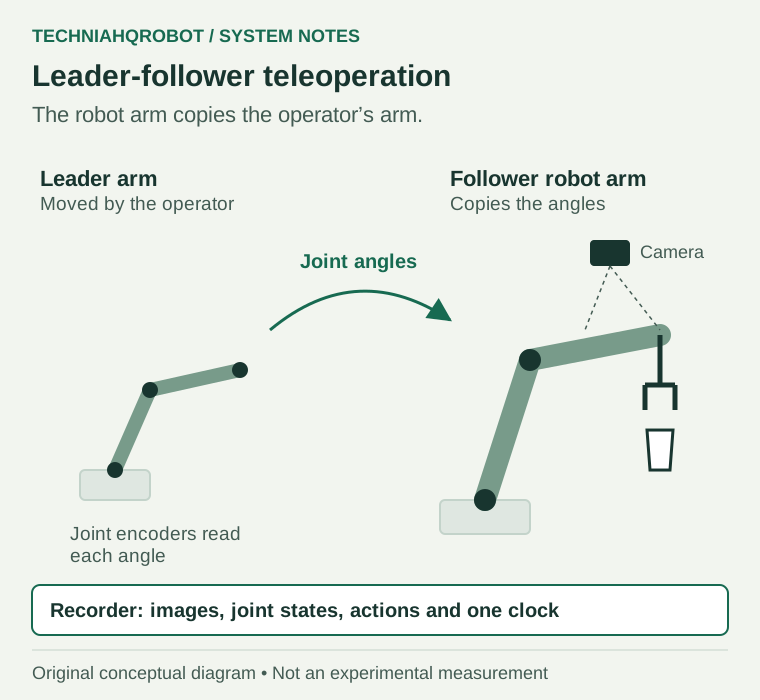
Each setup records different things. A leader-follower arm records robot joint angles directly. A hand-held gripper like UMI records the tool’s motion and camera view, and the robot has to be able to reproduce that motion later. The UMI authors note that the robot’s joint limits are unknown while the data is collected, so infeasible demonstrations have to be filtered out afterwards. [4] [1]
Timestamps and synchronization
Every stream runs at its own rate. In TWIST, motion capture ran at 120 Hz, retargeting and policy commands at 50 Hz, and the G1’s joint controller at 1,000 Hz. DROID recorded its cameras at 15 Hz. A recorder has to give every sample a timestamp from a common clock so that training can match an image with the joint state and the command from the same instant. [7] [2]
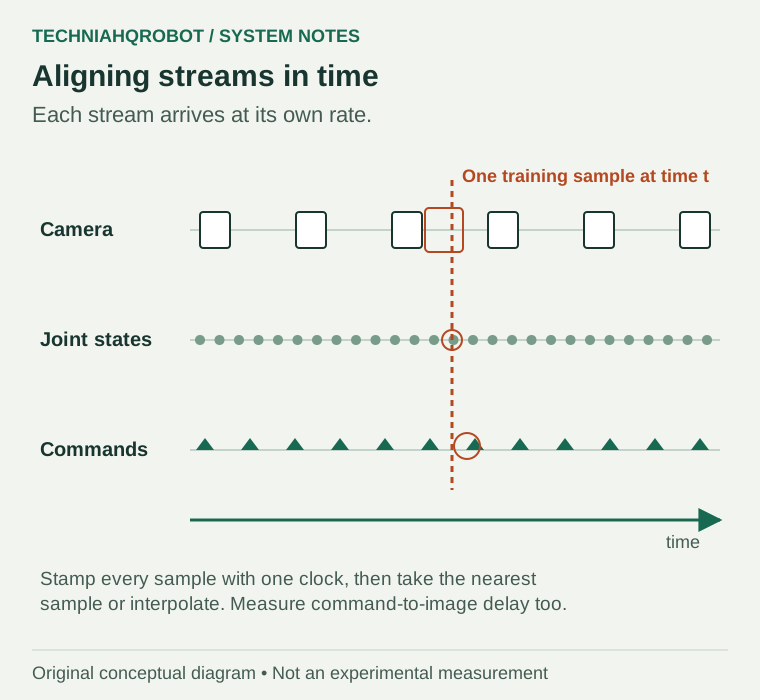
There is also delay. A command sent now shows up in the camera image a little later, after the motors move and the camera captures and transmits a frame. UMI handles this with inference-time latency matching, aligning observation streams and sending actions early to offset execution delay. LeRobot lets a training program ask for frames at offsets in seconds, such as 0.2 s and 0.1 s before the current frame. [4] [5]
Measuring command-to-response delay on a real robot is described in real-to-sim-to-real robotics.
How demonstrations are stored
Datasets need a format that keeps streams, rates and episode boundaries together. The Open X-Embodiment collection stores data in RLDS, a format built on serialized TFRecord files that supports different sensors and action spaces. LeRobotDataset v3 stores frame-by-frame states, actions and timestamps in Parquet files, camera video as MP4 files per camera, and the feature list, shapes and frames per second in a metadata file. Episode boundaries live in metadata rather than in file names. [9] [5]
Whatever the format, record the units, coordinate frames and camera calibration with the data. A joint angle without its unit or an image without its camera pose cannot be reused reliably by someone else. [10] [2]
Labelling and success criteria
Each episode needs at least a task description and an outcome. In DROID, collectors marked each episode as successful or not. About 16,000 unsuccessful trajectories are included in the release but are not counted in the 76,000 successful ones. Language instructions were added by crowdworkers, one to three per episode. [2]
Define success before recording, in physical terms. “Picked up the cup” is ambiguous. “Cup lifted at least 5 cm off the table and held for 2 seconds without slipping” can be checked by a person or by software. The same definition should be used later when the trained policy is evaluated, so that the two numbers mean the same thing.
Failed and interrupted attempts are worth keeping, with a clear label. They show what goes wrong, and some training and evaluation methods use them. Mixing them silently with successful demonstrations teaches the policy the mistakes. [2]
Quality checks before training
- Every stream present for the whole episode, with no dropped camera frames beyond a set limit.
- Timestamps increasing and on a common clock; stream offsets measured.
- Joint values inside their limits; no sudden jumps that indicate a sensor fault.
- Camera calibration recorded and checked; DROID found initial calibration could be inaccurate and refined it afterwards.
- Success label and task text present and consistent with the video.
- Episodes that a human interrupted or reset marked as such.
- Demonstrations that the target robot cannot reproduce removed or flagged.
Diversity: objects, scenes and viewpoints
A policy can only cope with variation it has seen. DROID was collected across 564 scenes in 52 buildings by 50 collectors at 13 institutions over 12 months, covering 86 tasks counted as unique verbs. Open X-Embodiment pooled more than a million trajectories from 22 robot types, and its authors report that the RT-X model trained on it improved several robots by using experience from other platforms. [2] [9]
Variation that matters includes different instances of the object, positions on the table, lighting, backgrounds, camera placement, and grasp attempts that slip or miss. Recording the same scene a thousand times usually adds less than recording a hundred scenes ten times each. [2]
Collecting, training and evaluating are three separate jobs
| Stage | What happens | What it proves |
|---|---|---|
| Collection | People control the robot and the system records episodes | That a person could do the task with this robot |
| Training | A learning algorithm adjusts model parameters to predict recorded actions | That the model fits the recorded data |
| Evaluation | The trained policy controls the robot alone in new trials | How often the robot completes the task under the test conditions |
| Deployment | The policy runs in its real environment with monitoring | How it performs over time, with interventions counted |
UMI shows why evaluation conditions matter. Its cup-arrangement policy succeeded in 20 of 20 trials in the lab, and about 72% of the time with new environments and cups. Open-TeleVision reported 92% picking and 88% placement success for a trained policy on an H1, measured as separate stages over five episodes. These are autonomous results after training, not the operator’s teleoperation score. [4] [11]
| Approach | Who chooses the actions | Data needed | Main limit |
|---|---|---|---|
| Teleoperation | A person, live | None in advance | Needs an operator for every run |
| Imitation learning | A trained policy, copying demonstrations | Many demonstrations | Fails in states the demonstrations never covered |
| Reinforcement learning | A policy improved by trial and reward | Many trials, usually in simulation | Reward design and the gap to real hardware |
| Autonomous execution | The robot’s software, alone | A trained or programmed controller | Must be evaluated in the real conditions |
Worked example: teaching a robot arm to pick up a cup
| Step | What happens | What to record or check |
|---|---|---|
| 1. Define the task | “Pick up the cup and place it on the saucer.” Success: cup upright on saucer, gripper open | Written success rule, list of cups and scenes |
| 2. Set up | Calibrate the wrist and fixed cameras; set the clock; check joint zero positions | Calibration files, software versions |
| 3. Demonstrate | The operator drives the arm with a leader arm, 50 times across 10 cups and 5 table positions | Images, joint states, gripper state, commanded actions, timestamps |
| 4. Label | Mark each episode success or failure; add the task text | Label consistent with video |
| 5. Check quality | Drop episodes with missing frames or broken timestamps; flag interrupted ones | Count of kept and removed episodes |
| 6. Store | Write episodes in a dataset format with metadata | Units, frames, calibration, FPS |
| 7. Train | Fit a policy that predicts actions from images and state | Training settings and data version |
| 8. Evaluate | Run the policy alone on cups and positions not used in training | Successes out of attempts, failures by type, interventions |
The final number is successes divided by attempts under stated conditions. Report the failures by type, such as missed grasp, slip, collision or wrong placement, because each one points to a different fix: more varied data, better calibration, or a different gripper.
Limits of teleoperation-based training
- Distribution shift: once the policy makes a small error, it sees situations no demonstration showed, and errors can compound.
- Operator style: different people solve the task differently, and inconsistent demonstrations are harder to learn from.
- Embodiment mismatch: human hands, VR controllers or hand-held tools do not move exactly like the robot.
- Missing senses: if the operator relied on touch or sound that was not recorded, the policy cannot learn it.
- Delay: lag in the teleoperation link changes how operators move, and that style ends up in the data.
- Cost: every demonstration needs a person’s time; UMI’s authors note that their tool is slower to use than bare-hand demonstration.
How the operator’s interface affects what is recorded is covered in how humanoid robot teleoperation works.
Privacy and consent
Robot cameras record whatever is in view: the operator, other people, rooms, screens and documents. Motion capture records how a specific person moves. In many places, recordings of identifiable people are personal data under privacy law.
- Tell operators and bystanders what is recorded and why, and get consent where it is required.
- Avoid recording faces, screens and documents that the task does not need, or blur them before sharing.
- Keep a record of where each episode was collected and under what agreement.
- Check the dataset licence and the consent terms before publishing or reusing data.
Sources and verification
- Learning fine-grained bimanual manipulation with low-cost hardware ↗Tony Z. Zhao, Vikash Kumar, Sergey Levine and Chelsea Finn, RSS 2023 · Read 8 October 2026
ALOHA is a fixed two-arm manipulation platform. ACT learns from recorded human control and predicts action sequences.
- DROID: A Large-Scale In-The-Wild Robot Manipulation Dataset ↗Alexander Khazatsky and colleagues, RSS 2024 · Read 15 October 2026
Read for 76k successful trajectories, about 350 hours, 564 scenes, 52 buildings, 86 tasks, 50 collectors at 13 institutions over 12 months, the Franka Panda with Robotiq 2F-85, two Zed 2 and one wrist Zed Mini cameras at 15 Hz, Meta Quest 2 teleoperation, collector success labels with about 16k unsuccessful episodes released separately, and post-hoc camera calibration.
- Imitation Learning ↗Russ Tedrake, MIT · Read 8 October 2026
Course notes on behavior cloning, observation histories and distribution shift. The article uses the supported definitions, not unfinished examples in the notes.
- Universal Manipulation Interface: In-The-Wild Robot Teaching Without In-The-Wild Robots ↗Cheng Chi and colleagues, RSS 2024 · Read 15 October 2026
Read for the hand-held gripper with a wrist GoPro as the only sensor, fisheye lens and side mirrors, visual-inertial pose tracking, inference-time latency matching, Diffusion Policy, cup arrangement at 20/20 in the lab and about 72% in novel settings, and the stated limits: texture needed for SLAM, kinematic feasibility filtering and slower collection than bare-hand demonstrations.
- LeRobotDataset v3.0 documentation ↗Hugging Face LeRobot · Read 15 October 2026
Read for meta/info.json with features, shapes and FPS, per-episode metadata in Parquet, tasks.jsonl, frame-level Parquet shards with observation.state, action and timestamp, MP4 video shards per camera, and delta_timestamps for time-aligned sampling. The page also shows an SO-101 leader-follower recording command.
- DIGIT – A Novel Design for a Low-Cost Compact High-Resolution Tactile Sensor ↗Lambeta et al., IEEE Robotics and Automation Letters · Read 8 October 2026
2020 paper hosted by a coauthor. Component-cost estimate is not a retail price.
- TWIST teleoperated whole-body imitation system ↗Yanjie Ze and colleagues · Read 8 October 2026
May 2025 manuscript associated with CoRL 2025. Unitree G1 real-world teleoperation and Booster T1 simulation are distinct.
- ACE a cross-platform visual-exoskeletons system for dexterous teleoperation ↗Shiqi Yang and colleagues, UC San Diego · Read 8 October 2026
August 2024 manuscript associated with CoRL 2024. Exoskeleton encoders measure wrist pose and hand-facing cameras measure fingers.
- Open X-Embodiment: Robotic Learning Datasets and RT-X Models ↗Open X-Embodiment Collaboration · Read 15 October 2026
Read for 22 robot embodiments, 1M+ real robot trajectories, 527 skills, 60 pooled datasets, the RLDS storage format and the authors' positive-transfer claim for RT-X. The paper gives 21 institutions in the abstract and 34 labs in Section III-A.
- ROS 2 tf2 coordinate frames ↗ROS 2 project · Read 8 October 2026
Official documentation source. Describes timestamped relationships between head, body, gripper and world coordinates. No claim that every humanoid uses ROS.
- Open-TeleVision teleoperation with immersive active visual feedback ↗Xuxin Cheng, Jialong Li, Shiqi Yang, Ge Yang and Xiaolong Wang · Read 8 October 2026
July 2024 manuscript. H1 and GR-1 upper-body setups, 60 Hz loop and separate autonomous-policy evaluation.
- Spinning Up – Key Concepts in Reinforcement Learning ↗OpenAI · Read 8 October 2026
Educational definitions of observations, actions, policies and rewards.
- A Reduction of Imitation Learning and Structured Prediction to No-Regret Online Learning ↗Stephane Ross, Geoffrey Gordon and Drew Bagnell, AISTATS 2011 · Read 8 October 2026
Original paper explains how earlier actions change the observations encountered later in imitation learning.
- AnyTeleop a general vision-based dexterous robot arm-hand teleoperation system ↗Yuzhe Qin and colleagues, RSS 2023 · Read 8 October 2026
Primary paper. Separate 25 Hz pose input and 120 Hz motion generation. Lists hand tracking and occlusion failures.
Article history
First version, written after a site audit found data collection covered only as one section of the teleoperation article.
Report a correction