Roger puts a specialist behind the controls
Roger is a humanoid from Minerva Humanoids, founded by Sandor Felber and Maurice Rahme. On October 6, 2026, Minerva announced approximately $10 million in pre-seed funding. General Catalyst led the round, with Long Journey Ventures and Credo Ventures as co-leads. Other participants included MVP Ventures, Kaya and Compound. [1]
Its intended work includes explosive ordnance disposal, hazardous-material response, offshore operations and high-voltage energy infrastructure. These are target applications; the announcement does not establish readiness for every environment. [1]
Minerva's industrial page describes inspection rounds and remote operation of valves and controls. Those tasks help explain the proposed body shape. A machine approaching equipment built around human reach needs to place its hands, support its weight and preserve a useful view while the operator works. [2]
The person chooses the critical action
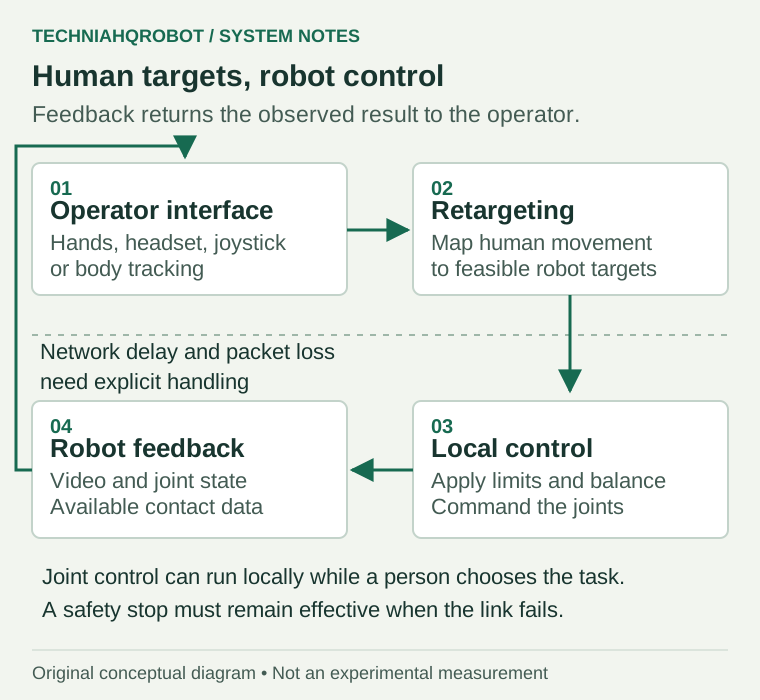
The manufacturer's interface combines a VR headset and haptic gloves. Robot cameras return the worksite view, operator movements travel toward Roger, and a touch channel returns feedback. The public pages leave camera resolution, glove hardware and tactile fidelity unspecified. [3] [4]
Minerva assigns balance, fall recovery, navigation and conversion of operator input to Minerva Intelligence. The specialist directs fine manipulation and retains control of critical actions. [1]
That division separates two decisions. The person can decide where a hand should go and whether to continue. The controller still needs to find movements that the robot's joints and current stance can support. A standing humanoid cannot copy a seated operator's arm movement without accounting for its own body.
This mapping is often called retargeting. AnyTeleop, a separate research system, maps human motion onto different robot arms and hands using their kinematic descriptions. It illustrates why the command needs conversion. Minerva has not identified that particular method as part of Roger. [5]
The public description leaves the navigation interface unresolved. It does not identify which navigation decisions come from the operator, how obstacle avoidance intervenes, or where each software component runs. Those details determine what a specialist must supervise during movement.
What the reported trials establish
Minerva reports a presentation at the NATO Explosive Ordnance Disposal Centre of Excellence in Samorin, Slovakia, and on-site public-safety testing while exploring two unnamed major airports. It describes German-built prototypes and first paid pilots planned for autumn 2026. [1]
A presentation establishes that a system was presented. A site test examines a particular setting. A paid pilot can still have temporary hardware and close engineering support. Evidence of routine commercial work would need an identified customer, operating dates, completed tasks and an account of interventions. The reviewed materials do not supply that record.
No public Roger test protocol in these sources reports payload, manipulation error, trial count, task success rate, battery runtime or delivered fleet size. The airport names and task conditions are also absent. That limits comparisons with other robots and prevents a numerical claim about operational reliability.
What happens when the view becomes uncertain
MBZUAI confirms a two-year research partnership covering visual and language interpretation, navigation, reinforcement learning, digital twins and simulation for energy applications. These are research areas. The university announcement does not contain Roger success rates in smoke or darkness. [6]
The engineering concern is shared visibility. Smoke can hide the same edge from both the operator's camera view and the robot's perception system. A person may then misunderstand clearance while software loses the features used to estimate motion. Losing a sensor adds another question about which measurements still support control.
For evaluation, describe the lighting, obstruction and failed sensor before reporting success. Record when the system detects uncertainty, what warning reaches the operator, and whether movement continues. A clear-air inspection result cannot establish performance when the target or floor is obscured.
Measure the age of the view and the command
NIST's radio-testing research describes how reflection, absorption and interference can reduce communication reliability and timeliness. It proposes controlled attenuation as a way to compare response-robot performance. Roger's communication equipment has no published equivalent result in the reviewed sources. [7]
Our engineering analysis separates camera-to-headset delay from operator-to-robot delay. An operator correcting a hand from an old image may send another movement after the previous one has already arrived. A fast update frequency alone does not reveal that age. Record timestamps and the spread of delays during the task.
A broken connection also needs a defined response for each activity. Holding an object, standing on an incline and walking through a narrow passage create different constraints. Request measured stopping and recovery behaviour rather than treating a communications claim as evidence that every interruption is handled.
Measure the complete task with the operator
NIST's response-robot programme evaluates mobility, manipulation, sensing, communications and operator proficiency. Following that measurement logic, the table proposes questions for a Roger evaluation. These are editorial proposals, not tests already passed by Minerva. [8]
| Condition | Record | What the record would explain |
|---|---|---|
| Obstacles and unstable footing | Surface, route, contacts, falls and assistance | Whether the body maintained support while the operator worked |
| Difficult two-hand manipulation | Object geometry, load, placement error, slips and retries | Whether the hands completed the intended action without losing the object |
| Restricted visibility or sensor loss | Visibility level, available sensors and operator warnings | Which observations remained usable and when the task stopped |
| Delayed or interrupted communication | Video age, command age, interruption length and resulting motion | How stale information affected the operator and controller |
| A complete work session | Attempts, duration, interventions, resets and operator experience | Whether the result was repeatable across people and sessions |
Fall recovery deserves separate reporting. Standing up after a controlled fall does not establish that surrounding equipment, the robot or a carried object avoided damage. Similarly, a precise hand movement on a clear bench leaves open how arm loading changes balance on an uneven surface. Roger's next useful evidence would connect those stages in repeated, documented tasks.
Sources and verification
- Minerva announces Roger and pre-seed funding ↗Minerva Humanoids via GlobeNewswire · Read 10 October 2026
October 6, 2026 company announcement. Financing and reported trials are company statements. No trial dataset or customer acceptance record is supplied.
- Roger oil and gas applications ↗Minerva Humanoids · Read 10 October 2026
Intended inspection, valve and control tasks. An interactive offshore scenario is not evidence of a completed offshore customer deployment.
- Roger teleoperation overview ↗Minerva Humanoids · Read 10 October 2026
Manufacturer page describing visual, movement and touch channels. Its interactive figures are not treated as measured operating results.
- Roger public safety platform ↗Minerva Humanoids · Read 10 October 2026
Manufacturer identifies a VR headset and haptic gloves. It provides no measured tactile resolution, camera specifications or end-to-end latency in the retrieved text.
- AnyTeleop arm and hand teleoperation research ↗Yuzhe Qin and colleagues, RSS 2023 · Read 10 October 2026
Primary paper used only to explain motion retargeting in general. There is no evidence Roger uses AnyTeleop.
- MBZUAI and Minerva research partnership ↗Mohamed bin Zayed University of Artificial Intelligence · Read 10 October 2026
University announcement dated January 29, 2026. Two-year research programme covering perception, learning and simulation. Research objectives are separate from Roger performance results.
- Response robot testing under attenuated radio conditions ↗Kenneth Kimble, Richard Candell and Kamel Saidi, NIST · Read 10 October 2026
NISTIR 8243, May 21, 2019. Discusses environment-dependent radio degradation and repeatable evaluation. Does not test Roger.
- Standard test methods for response robots ↗National Institute of Standards and Technology · Read 10 October 2026
Describes measurement categories and operator proficiency. Used as context for an original proposed evaluation, not as Roger certification.
Evidence limits
- Request camera and haptic specifications, measured control delays and documented connection-loss behaviour.
- Request customer identification, trial protocols and repeated task results before describing a commercial deployment.
Article history
Added a sourced account of Roger control responsibilities, reported trials and missing evaluation data.
Report a correction