The short answer
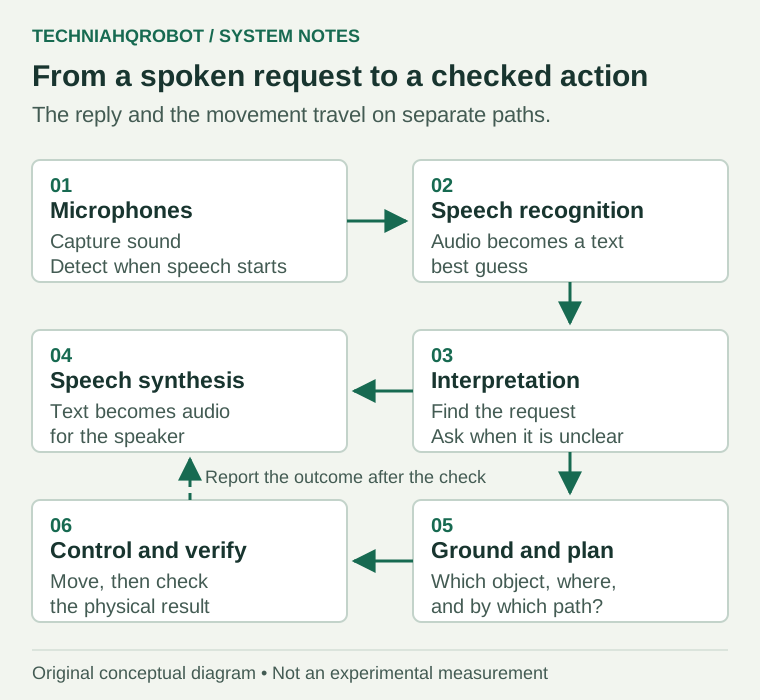
A talking robot chains several separate systems. Microphones capture sound. Speech recognition turns the sound into a best-guess text. A language component works out what was asked and writes a reply. Text-to-speech turns the reply into audio for a loudspeaker. None of those steps moves a joint.
Following a spoken instruction needs a second path. The request has to be turned into something the robot’s perception, planning and control software can execute, and then the result has to be checked in the physical world. A robot that says “I will bring the cup” has produced a sentence. Bringing the cup is a different, separately testable outcome. [1]
A simple picture: the waiter and the kitchen
Think of a restaurant. The waiter listens to your order, writes it on a ticket and tells you it is on its way. The kitchen reads the ticket and cooks. Listening, writing and speaking are the robot’s speech system. Cooking is its body, controlled by other software.
The comparison has a limit, and the limit is the point. In a restaurant, the same person who promised the dish can usually check the kitchen. In a robot, the reply and the action can come from different programs that do not automatically agree. The waiter can say “coming right up” while the kitchen has no ingredients. A well-designed robot reports the outcome only after a check has confirmed it.
Hearing: microphones and the noise around a robot
Many robots carry several microphones rather than one. Pollen Robotics lists four PDM microphones on a Seeed reSpeaker XMOS XVF3800 board in Reachy Mini, sampling at up to 16 kHz, together with a 5 W speaker. Unitree lists a four-microphone array and a speaker for the standard R1. These are manufacturer hardware descriptions, not measurements of how well either robot hears. [2] [3]
An array helps because sound reaches each microphone at a slightly different time. Software can use those differences to estimate where a voice comes from and to favour sound from that direction, a family of methods called beamforming. A robot is also a noisy place to listen: motors, gearboxes and cooling fans run while it moves, and its own loudspeaker can feed back into its microphones. Echo cancellation subtracts the robot’s own voice from what the microphones record.
Before recognition, software has to decide when someone is speaking at all. This is voice activity detection. The Whisper speech model, for example, predicts a no-speech probability for each segment, and its authors report that combining a no-speech threshold with a confidence threshold made that detection more reliable. Getting this wrong cuts off the start of a request or sends background noise to the recognizer. [4]
Speech recognition: from sound to a text guess
Automatic speech recognition, or ASR, converts audio into text. Whisper is a well-documented example. Its authors resample audio to 16,000 samples per second, convert it into an 80-channel log-Mel spectrogram using 25 ms windows every 10 ms, and process it in 30-second segments with an encoder-decoder Transformer. The models were trained on 680,000 hours of audio paired with transcripts. [4]
Two terms need defining. A spectrogram is a picture of sound: time runs along one axis, pitch bands along the other, and brightness shows how much energy each band holds at each moment. The Mel scale spaces those bands roughly the way human hearing separates pitches. An encoder-decoder model first turns the whole spectrogram into an internal representation, then writes the text one token at a time. [4]
The output is the model’s most likely text, not a certain record of what was said. The Whisper paper reports that all tested models degrade as background noise becomes more intense, with Whisper doing better than models trained only on clean audiobook speech under pub noise. It also lists errors that a person would rarely make: getting stuck repeating a phrase, skipping the first or last words of a segment, and occasionally writing a transcript unrelated to the audio. [4]
Robots use different recognizers, and some do not run on the robot at all. The UCLA PhoneBot paper describes speech-to-text, language-model and text-to-speech features as backend calls over Wi-Fi, separate from the walking loop that runs on the phone. Where recognition happens decides what fails when the network drops. [5]
Interpretation: from text to a request the robot can act on
A transcript such as “put the red cup in the sink” still has to be turned into parts the robot can use: an action (put), an object (the red cup), a destination (the sink) and any conditions. Words like “that one” or “over there” cannot be resolved from text alone. They need the camera view, and sometimes where the person is pointing or looking. When two objects match, a careful system asks instead of guessing. [1]
Language models connect to robot actions in a few documented ways. They differ in what the model outputs, and therefore in what still has to check that output. [6] [7] [8]
| Pattern | What the language model produces | Documented example | What still has to check it |
|---|---|---|---|
| Skill selection | A score for each skill the robot already has | SayCan combines language-model scores with learned estimates of each skill’s chance of success on an Everyday Robots mobile manipulator | The skill’s own controller and its success check |
| Code generation | A short program that calls perception and control functions | Code as Policies wrote Python for a UR5e arm on a tabletop and for an Everyday Robots kitchen robot | The functions it calls, joint limits and collision checks |
| Direct action model | Action tokens or targets, from images plus the instruction | RT-2 outputs robot actions as tokens from a vision-language-action model | Low-level control and safety limits on the robot |
Each approach is limited by what lies underneath it. The Code as Policies authors write that their method is restricted by what the perception functions can describe and by a handful of control primitives, that it struggles with long or complex commands, and that it assumes every instruction is feasible. A model cannot pick up an object that the vision system cannot find. [7]
The full chain from an instruction to a placed object is traced in how humanoid robots make decisions. That article follows a bottle through perception, planning, control and verification.
Speaking back: text-to-speech
Text-to-speech, or TTS, runs the recognition problem in reverse. Tacotron 2 is a documented two-stage design: a sequence-to-sequence network predicts a mel spectrogram from the input characters, and a modified WaveNet model, called a vocoder, turns that spectrogram into an audio waveform. In the authors’ listening test, people rated its speech 4.53 on a five-point scale, against 4.58 for professional recordings. [9]
Newer systems use different architectures, but the lesson holds: a natural-sounding voice measures the speech synthesizer. It says nothing about whether the robot understood the request or can do the task it is describing. [9]
Talking is not doing
Generating a response and executing a physical action are different operations with different evidence. A reply is finished when the audio has played. An action is finished when the object is where it should be, which the robot can only know by looking or measuring again.
SayCan shows the gap with numbers. Across 101 instructions in a real office kitchen, PaLM-SayCan produced a correct plan 81% of the time, but the robot executed the task successfully 60% of the time. Human raters judged the plan and the execution separately. A system that announced success whenever it had a plan would have overstated its results. [6]
This is also why a spoken claim in a demonstration video needs checking. A robot can talk on its own while a person moves its arms through teleoperation. The voice and the motion are separate systems, and the voice does not reveal who chose the motion.
The operator’s side of that arrangement is described in how humanoid robot teleoperation works.
Follow one spoken request
| Step | What happens | What can go wrong, and the safer response |
|---|---|---|
| 1. Capture | The microphones record “Please put the red cup in the sink.” | Motor noise masks a word. Ask the person to repeat. |
| 2. Detect speech | Voice activity detection marks the start and end of the request. | The start is cut off. Keep a short audio buffer from before the detection. |
| 3. Recognize | ASR returns a text guess with a confidence value. | Low confidence or an unexpected phrase. Read the request back before acting. |
| 4. Interpret | Software extracts the action, object and destination. | The request is ambiguous or outside the robot’s skills. Say so instead of improvising. |
| 5. Ground | Perception finds red cups and the sink in the robot’s coordinates. | Two red cups are visible. Ask which one. |
| 6. Plan and move | Motion planning and control carry out the grasp and transfer. | Unexpected contact or slip. Stop or run the configured recovery. |
| 7. Verify | The camera, and touch or force sensing where available, confirm the cup is in the sink. | The check fails. Report the failure, not the intention. |
| 8. Reply | TTS says “The cup is in the sink.” | Speaking before step 7 risks announcing a task that did not happen. |
Every step adds delay. The total time from the end of the sentence to the first motion depends on where recognition runs, how large the language model is and how the robot plans. Measure it on the robot rather than adding up figures from different papers.
Can a humanoid robot hold a conversation?
If a large language model is connected, a robot can produce fluent conversation. Holding a useful conversation in a room is harder. People interrupt each other, talk over the robot, refer back to things said minutes ago and point at objects. The robot has to decide who is speaking, when its turn begins, what “it” or “that” refers to, and whether a remark is a request at all.
Fluent text also hides recognition errors. In a 2023 study of Whisper’s API on recordings from AphasiaBank, about 1% of transcriptions contained whole phrases or sentences that the speaker never said, and 38% of those hallucinations contained content the authors classed as harmful. Hallucinations were associated with longer pauses, which were more common among speakers with aphasia. The result describes that service version and dataset, but it shows why a robot should not treat every transcript as fact. [10]
Talking about the scene is a further step. A language model can describe a kitchen fluently from its training data alone. Whether the robot actually perceives the kitchen in front of it depends on its cameras and perception software, not on how well it speaks.
Where voice control fails
| Problem | Why it happens | How engineers test or reduce it |
|---|---|---|
| Noise and distance | Motors, fans, other voices and room echo mask speech | Record test phrases through the robot’s own microphones in the real workplace |
| Different voices | Accents, speech conditions and children’s voices may be under-represented in training data | Measure errors separately for each group of speakers |
| Invented transcripts | Recognizers can output words that were not spoken | Read back critical requests, log audio with transcripts, require confirmation |
| Ambiguous references | “That one” has no meaning without the scene | Ground words in perception and ask when more than one object matches |
| Network loss | Cloud recognition or language models stop responding | Define behaviour when the link drops, and keep local stop functions |
| Misheard safety commands | A spoken “stop” can be missed in noise | Keep a physical emergency stop that does not depend on speech |
| Privacy | Microphones that wait for a wake word are always processing sound | Document what is recorded, where it is sent and how long it is kept |
The safety point deserves emphasis. Voice is a convenient way to ask for a task. It should not be the only way to stop one, because the same noise and recognition errors that garble a request can garble the word “stop”.
Questions to ask about a talking robot
- Does speech recognition run on the robot or in the cloud, and what happens offline?
- Was the spoken request scripted for the demonstration or chosen freely?
- Who chose the arm and leg motions: the robot’s software or a remote operator?
- How does the robot respond when it mishears or when two objects match?
- Does it report success after a check, or as soon as it has a plan?
- How many attempts, retries and human interventions were there?
For the wider question of which decisions a robot makes by itself, read are humanoid robots autonomous?.
Vision-language-action models are explained separately in vision-language-action models explained.
Sources and verification
- Robotic Manipulation Perception, Planning and Control ↗Russ Tedrake, MIT · Read 8 October 2026
Course introduction separates semantic and geometric perception, task planning, physical constraints and contact control.
- Reachy Mini hardware datasheet ↗Pollen Robotics · Read 13 October 2026
Datasheet read for size, mass, degrees of freedom, motor names, camera, microphones, speaker, battery and the Wireless compute module.
- Unitree R1 specifications ↗Unitree Robotics · Read 8 October 2026
- Robust Speech Recognition via Large-Scale Weak Supervision ↗Alec Radford and colleagues, OpenAI · Read 15 October 2026
Whisper paper, arXiv:2212.04356 (December 2022). Read for the 680,000-hour training set, 16 kHz input, 80-channel log-Mel spectrogram with 25 ms windows and 10 ms stride, 30-second segments, encoder-decoder Transformer, no-speech handling, noise results and the limitations section on repeat loops, skipped words and hallucinated transcripts.
- PhoneBot: A Low-Cost Open Humanoid Robot Platform Reusing Smartphones ↗Ruochen Hou, Quanyou Wang, Daniel Koh and Dennis W. Hong, UCLA RoMeLa · Read 13 October 2026
arXiv:2610.08737, submitted 6 October 2026. The HTML version at arxiv.org/html/2610.08737v1 was read for hardware, the 50 Hz action loop, phone split, symmetry figures and stated limits. Project page: https://phonebot.dev.
- Do As I Can, Not As I Say Grounding Language in Robotic Affordances ↗Michael Ahn and colleagues, Robotics at Google and Everyday Robots · Read 8 October 2026
2022 research paper. Table 2 gives 84% planning and 74% execution in the mock kitchen, versus 81% and 60% in the real kitchen, across 101 instructions. A mobile manipulator was used.
- Code as Policies: Language Model Programs for Embodied Control ↗Jacky Liang and colleagues, Google · Read 15 October 2026
arXiv:2209.07753 (ICRA 2023). Read for language-model-written Python that calls perception and control APIs, the UR5e tabletop, whiteboard and Everyday Robots kitchen demonstrations, and the stated limits: perception API scope, a few control primitives, long or complex commands, and the assumption that instructions are feasible.
- RT-2 – Vision-Language-Action Models Transfer Web Knowledge to Robotic Control ↗Brohan et al. · Read 8 October 2026
Section 5 states that web pretraining does not itself add new physical motions.
- Natural TTS Synthesis by Conditioning WaveNet on Mel Spectrogram Predictions ↗Jonathan Shen and colleagues, Google · Read 15 October 2026
Tacotron 2 paper, arXiv:1712.05884 (ICASSP 2018). Read for the two-stage design, a sequence-to-sequence network predicting mel spectrograms from characters followed by a modified WaveNet vocoder, and the reported mean opinion score of 4.53 against 4.58 for professional recordings in the authors' listening test.
- Careless Whisper: Speech-to-Text Hallucination Harms ↗Allison Koenecke and colleagues, ACM FAccT 2024 · Read 15 October 2026
HTML version v2 read. Whisper API queried in April and May 2023 on 13,140 AphasiaBank segments from 437 speakers. About 1% of transcriptions contained hallucinated phrases or sentences, and 38% of those contained harms identified by the authors. Hallucinations were associated with longer non-vocal durations. Results describe that API version and dataset.
Article history
First version, written after a site audit found no page on robot hearing, speech recognition, speech synthesis or voice-to-action control.
Report a correction