Can GTA 6 train a humanoid robot?
In principle, yes for some learning tasks, provided researchers can access the environment through an authorized interface. GTA 6 could supply visually varied streets, buildings, moving obstacles and long-horizon objectives to test perception and decision-making. It cannot be assumed to reproduce the joint torques, foot contacts and actuator limits of a physical humanoid. A separate robot physics simulator and controlled hardware experiments would still be needed.
Rockstar launched Grand Theft Auto VI on 19 November 2026 for PlayStation 5 and Xbox Series X|S. Its public announcement describes a game set in Leonida and Vice City, not a robotics platform. As of 20 November 2026 we found no verified public GTA VI integration for training or deploying a Unitree G1 controller. [Source ↗]
The useful research question is what can transfer from a game to a robot. Three projects already explored GTA V for vision, embodied evaluation and programmable training tasks. [2] [3] [Source ↗]
Watch TechniaHQRobot on YouTube
Visit the TechniaHQRobot YouTube channel for robotics engineering and Physical AI videos. TechniaHQRobot on YouTube.
What researchers have already done with GTA V
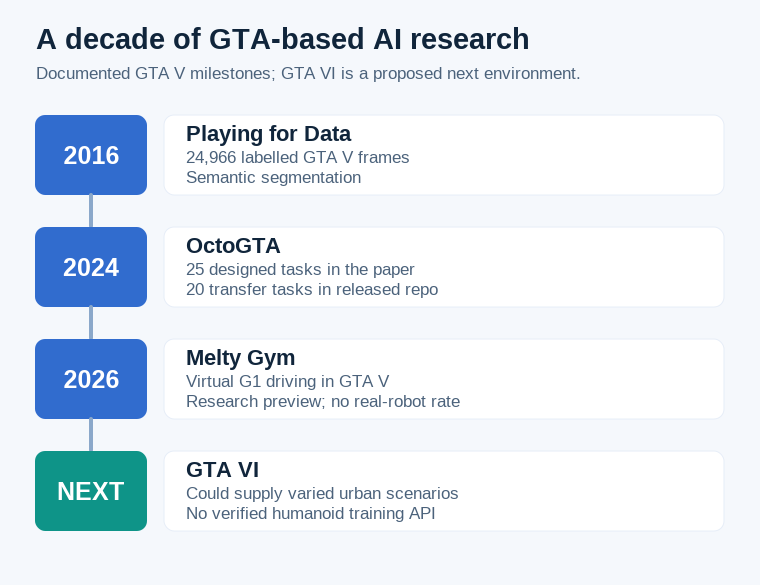
2016 - Playing for Data: synthetic vision datasets
Researchers Stephan Richter, Vibhav Vineet, Stefan Roth and Vladlen Koltun from TU Darmstadt and Intel Labs extracted 24,966 densely annotated frames from GTA V. Their method recovered information from the graphics pipeline to accelerate semantic labeling. The team combined synthetic images with real images to train a semantic segmentation model. In the reported CamVid comparison, game data combined with one third of the real training set outperformed training with the full CamVid training set alone. [2]
Semantic segmentation identifies the class of individual image pixels, such as road, vehicle or building. This work is relevant to robot perception. It did not teach an actual humanoid to balance, walk or grasp; it also does not establish that GTA VI images have the same value. The released dataset is identified as research and educational use only. [2]
2024 - OctoGTA: embodied vision-language planning
Octopus, presented at ECCV 2024, connects visual observations and language instructions to executable action code. The paper describes 19 GTA V functions and 25 designed tasks across five groups, with five locations per task. The authors' released repository separately lists 20 tasks for transfer-learning evaluation. These are distinct counts, and should not be treated as interchangeable. [3] [Source ↗]
The environment encourages visual perception rather than giving the model a function that automatically reaches a target object. The agent can choose a sequence of game actions as it reacts to the environment. Its results address embodied reasoning at the game interface. They do not measure a physical robot's balance or contact forces. [3]
2026 - Melty Gym: programmable video games for robotics
David Miller's Melty Gym announcement describes a research preview in which teams can insert robot models and adjust game mechanics, task objectives and interactions. The launch material shows a virtual G1 driving in GTA V and robots working near racks in a separate custom Data Center environment. These are virtual demonstrations. The announcement does not disclose a measured success rate for physical G1 deployment after game training. [Source ↗]
| Research | Environment | What was demonstrated | What remains unproven |
|---|---|---|---|
| Playing for Data (2016) | GTA V rendered images | Pixel-label dataset and improved segmentation experiment | Humanoid motion and manipulation |
| OctoGTA (2024) | GTA V game interface | Vision-language planning and executable commands | Robot joint control and real-world transfer |
| Melty Gym (2026) | GTA V and custom world | Configurable virtual robot tasks | Quantified sim-to-real transfer |
| GTA VI (proposed) | Vice City and Leonida | No confirmed robot training integration | Authorized task API and hardware results |
What could GTA 6 teach a robot?
| Task | Game could provide | Robot simulator must provide |
|---|---|---|
| Autonomous navigation | Routes, obstacles, visual landmarks | Localization, camera calibration, collision geometry |
| Stair climbing | Stair layouts and target routes | Individual steps, friction, foot pressure, joint dynamics |
| Object handling | Scene variety and language goals | Grasp contacts, mass, inertia, finger torques |
| Package delivery | Multi-step missions and moving obstacles | Safe carrying, object stability and recovery |
| Vehicle interaction | Visual layout and navigation goals | Seat entry, hand forces, vehicle controls, safety validation |
The best use would be to separate task planning from physical motion. A game could help a policy identify a destination or decide a sequence of actions. A robotics model would then solve the motion using sensors and motor commands for the specific robot. For tasks such as opening a door, the game could define the goal while the physics simulator evaluates whether the hand can reach the handle and apply the required force.
A moving NPC in a game is useful for developing a navigation planner. It is not a calibrated model of human behavior or a substitute for an independent safety system. A real robot must avoid people and objects even when its visual planner fails.
Why GTA graphics are not enough for humanoid robot physics
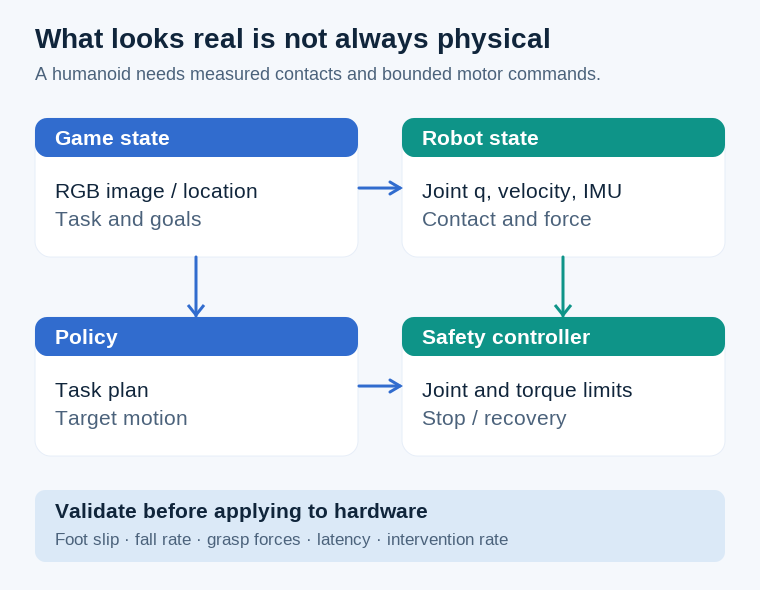
A realistic-looking staircase can still have simplified game collision geometry. A humanoid has to place each foot on an actual surface and keep its center of mass within the support constraints, including during single-foot stance. Its controller needs the positions and velocities of joints, base orientation from an IMU, contact states and other observations available to its particular hardware.
Sim-to-real transfer depends on how well simulated dynamics match the physical machine: link mass and inertia, gear friction, backlash, motor torque and speed limits, control delay, sensor noise and foot-ground friction. A visual policy trained with a game camera also faces changes in field of view, exposure, lighting and motion blur when moved to a robot camera.
Manipulation has another problem. A virtual hand may pass through objects or use an animation to complete a task. A real robotic gripper must generate the right contact forces without slipping or crushing the object, and the robot must keep its balance while reaching.
| In a game | What to measure in robot simulation |
|---|---|
| Player speed or location | Joint trajectory, torque, base velocity and stability |
| Collision event | Contact position, force, friction and impact |
| Scripted interaction | Grasp pose, reachability and force closure |
| Mission completion | Task success, quality, safety and interventions |
Software for connecting a virtual city to humanoid robot training
There is no documented ready-made GTA VI connector in the sources reviewed. A researcher can nevertheless build a comparable workflow today using legally usable environments and existing robot software. [Source ↗] [Source ↗] [1]
| Software | Role in the workflow |
|---|---|
| NVIDIA Isaac Lab / Isaac Sim | Reinforcement learning, robot articulations, visual observations, physics and domain randomization |
| MuJoCo | Independent physics simulation and validation of robot controllers |
| Unitree RL Lab | G1-compatible training, policy evaluation and documented transfer workflow |
| ROS 2 | Communication between perception, planning and robot nodes |
| Python / PyTorch | Data processing, training networks and recording model outputs |
| URDF or USD robot descriptions | Exact link geometry, joints, inertias and actuator configuration |
| Authorized game adapter (proposed) | Provide observations, task commands and safe resets from a permitted game environment |
[Source ↗] [Source ↗] [1] [Source ↗]
For example, the official Unitree RL Lab repository lists a G1 29-DOF velocity training task in Isaac Lab. It then describes validation of a trained policy in MuJoCo before deployment on the corresponding hardware. The robot model, firmware, controller and observation mappings must match. This is an existing robotics workflow independent of GTA VI. [1]
git clone https://github.com/unitreerobotics/unitree_rl_lab.git
cd unitree_rl_lab
# Follow the repository's setup and robot asset instructions first.
./unitree_rl_lab.sh -l
./unitree_rl_lab.sh -t --task Unitree-G1-29dof-Velocity
./unitree_rl_lab.sh -p --task Unitree-G1-29dof-Velocity
These commands follow the documented simulation workflow and are not instructions for running a robot in GTA VI. Check the current repository's dependency requirements before installation. Do not send an unvalidated policy to powered hardware.
A proposed GTA 6 to Isaac Lab to real robot pipeline
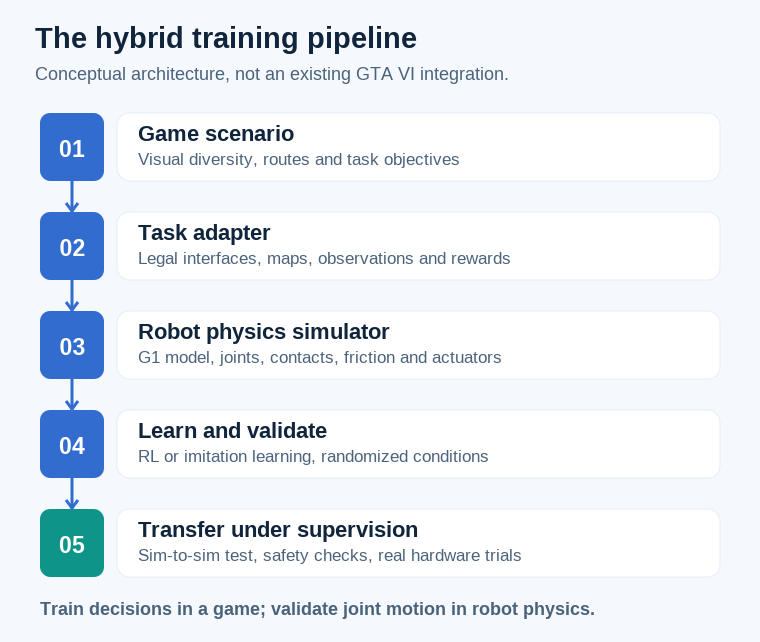
The game and physics simulator should remain separate systems connected at the task level. Start with a goal such as navigate from a building entrance to a delivery point. A permitted adapter would provide the environment observations and target. A task planner would select waypoints or actions. The physics simulator would execute a robot-specific controller and return reward or failure signals.
- Create legally usable task scenes from original or licensed assets. Verify access terms before extracting game data or modifying a commercial title.
- Load the specific humanoid model with the correct number of joints and actuator constraints.
- Define observations: camera frames, joint position and velocity, IMU, command history and contact estimates as available.
- Train a high-level planner with imitation learning or reinforcement learning, and train the low-level controller in a physics simulator.
- Randomize friction, mass, latency, camera lighting and sensor noise to cover plausible variation. Keep a held-out test set.
- Validate the same policy in a second physics environment, then conduct hardware testing under appropriate supervision and manufacturer procedures.
Reinforcement learning exposes an agent to repeated episodes and rewards its successful behavior. Imitation learning instead starts from demonstrations. A vision-language-action model can map image observations and language instructions to action targets, but the controller still needs to respect the robot's kinematic and dynamic limits. [Source ↗] [1]
How to test whether GTA-style training actually transfers
Use a simple comparison: train two policies on the same navigation problem, one with only robotics-simulator scenes and one with added legally usable game-style visual diversity. Keep the physical controller, reward, test locations, compute budget and success criteria consistent. This would help isolate whether the additional visual data improves generalization rather than merely adding more training.
| Experiment stage | Measurements |
|---|---|
| Held-out virtual scenes | Goal success rate, path length, collision count, completion time |
| Independent robot physics | Falls per trial, foot slip, torque saturation, tracking error |
| Supervised hardware trial | Successful attempts / total trials, interventions, safety stops, cycle time |
| Failure analysis | Lighting changes, sensor errors, incorrect commands, contacts and recovery |
Report unsuccessful attempts as well as successes. If a robot reaches the destination but a safety operator has to prevent a fall, record that intervention. Compare the same task in simulation and reality using the same success definition. No success rate is assigned to GTA VI without measured results.
Advantages and limitations
| Advantages | Limitations |
|---|---|
| Large and diverse virtual environments | Commercial game access and compatible interfaces may be unavailable |
| Repeatable task scenarios and resets | Physics may not match robot dynamics |
| Visual diversity for perception | Game images may differ from camera observations |
| Many possible long-horizon objectives | No public proof of physical humanoid transfer from GTA VI |
Researchers need legal permission for game assets, safe test facilities and robot-specific models. The public launch of a game does not grant access to its internal physics, training APIs or redistribution of its content. A licensed or original scene inspired by a virtual city would be a workable fallback if commercial game access is unsuitable.
Frequently asked questions
Has a real humanoid robot been trained using GTA 6?
No verified result was found as of 20 November 2026. Public examples reviewed concern GTA V or other robotics simulators, and virtual task execution should not be confused with real robot deployment.
Can GTA 5 train artificial intelligence?
Yes. Playing for Data and OctoGTA show that GTA V can support vision research and embodied-agent evaluation; Melty's preview proposes programmable tasks for robot research. [2] [3] [Source ↗]
Can a Unitree G1 learn to walk inside GTA 6?
A game avatar moving like a G1 is insufficient to train its real joint controller. A G1-specific physics model with contact dynamics, actuator limits and sensor observations would need to be used. Unitree's official RL Lab provides an independent simulation workflow. [1]
Is GTA 6 better than MuJoCo or NVIDIA Isaac Lab for robotics?
They serve different purposes. GTA VI is a commercial entertainment game. MuJoCo and Isaac Lab offer robot-focused physics and learning interfaces. It may be useful to combine authorized game-derived tasks or visuals with robot simulation, but no superiority has been established. [Source ↗] [Source ↗]
Which programming language is needed?
Python is commonly used for data processing and policy training. ROS 2 and robot SDKs can connect software components where supported. The exact stack depends on the robot, simulator and any authorized game interface. [Source ↗] [1]
How to install the software mentioned on this page
Choose only the tools required for your project. The commands below describe development and simulation setup, not proof of compatibility with a specific physical robot. Match the versions in the original project and test offline before connecting hardware.
Python Windows, macOS, Linux
Install the Python release required by your robot or library. On Windows use the official installer; on Ubuntu use the distribution package. Create a separate virtual environment for each project.
Installation / setup commands
python -m venv .venv
# Windows PowerShell:
.\.venv\Scripts\Activate.ps1
# Linux or macOS:
source .venv/bin/activate
Verify the installation
python --version
python -m pip --version
Official instructions: https://www.python.org/downloads/
Git Windows, macOS, Linux
Install Git from the official download page or your package manager. On Ubuntu the commands below install the command-line client; on Windows run Git for Windows.
Installation / setup commands
sudo apt update
sudo apt install git
Verify the installation
git --version
Official instructions: https://git-scm.com/downloads
MuJoCo Windows, macOS, Linux
Create a Python virtual environment and install the official Python package. On macOS use mjpython for the interactive viewer when required.
Installation / setup commands
python -m pip install mujocoVerify the installation
python -c "import mujoco; print(mujoco.__version__)"
Official instructions: https://mujoco.readthedocs.io/en/stable/python.html
NVIDIA Isaac Sim Supported Windows/Linux workstation with compatible NVIDIA GPU
Check NVIDIA's GPU, driver, OS and Python compatibility matrix. This is a documented example for Isaac Sim 5.1.0 in a Python 3.11 virtual environment; use the release required by your project and accept the applicable license when prompted. Do not mix incompatible releases.
Installation / setup commands
python -m pip install --upgrade pip
python -m pip install "isaacsim[all,extscache]==5.1.0" --extra-index-url https://pypi.nvidia.com
Verify the installation
python -m pip show isaacsim
isaacsim
Official instructions: https://docs.isaacsim.omniverse.nvidia.com/5.1.0/installation/install_python.html
NVIDIA Isaac Lab Supported Linux or Windows configuration
The following is a version-pinned example for Isaac Lab 2.3.1 with Python 3.11. Check the matching Isaac Sim release, supported GPU and operating system. Install the compatible PyTorch build for your computer using the same version's documentation. For other releases, follow their own installation guide.
Installation / setup commands
python -m pip install --upgrade pip
python -m pip install "isaaclab[isaacsim,all]==2.3.1" --extra-index-url https://pypi.nvidia.com
Verify the installation
isaacsim
Official instructions: https://isaac-sim.github.io/IsaacLab/v2.3.1/source/setup/installation/isaaclab_pip_installation.html
ROS 2 (Jazzy example) Ubuntu 24.04 for Jazzy; other distributions have different instructions
On Ubuntu 24.04 first configure the official ROS apt repository using the documented ros2-apt-source procedure. Then install Jazzy desktop. Use the distribution required by your robot; for example Humble normally uses Ubuntu 22.04.
Installation / setup commands
sudo apt update
sudo apt install ros-jazzy-desktop
source /opt/ros/jazzy/setup.bash
Verify the installation
ros2 --help
Official instructions: https://docs.ros.org/en/jazzy/Installation/Ubuntu-Install-Debs.html
PyTorch Windows, Linux, macOS with supported Python
Use the official installation selector for your OS, CPU or CUDA/ROCm version. Run the exact command it produces inside the project's environment. Do not assume that a CPU wheel has GPU support.
Verify the installation
python -c "import torch; print(torch.__version__, torch.cuda.is_available())"
Official instructions: https://pytorch.org/get-started/locally/
Unitree RL Lab Linux and compatible Isaac Lab environment
Select matching Isaac Lab and Unitree repository revisions. Install Isaac Lab first, clone the RL Lab repository and follow its README for the editable project package and sample training tasks. Use simulation only until the model has been reviewed.
Installation / setup commands
git clone https://github.com/unitreerobotics/unitree_rl_lab.gitVerify the installation
Run the repository's documented simulation task.
Official instructions: https://github.com/unitreerobotics/unitree_rl_lab
OctoGTA (Octopus project) Windows 11 research environment
Clone the authors' research repository and follow the octogta subdirectory setup instructions with a legitimate, compatible GTA V installation. The published test suite is for GTA V; it is not a GTA VI integration.
Installation / setup commands
git clone https://github.com/dongyh20/Octopus.git
cd Octopus/octogta
Verify the installation
Use the repository's documented evaluation environment; check that game version and dependencies match.
Official instructions: https://github.com/dongyh20/Octopus
Melty Gym Research access / platform-dependent
The founder's launch announcement describes the research platform, but does not provide a verified public installation command for the robotics environment. Ask the provider for access, a compatible game version and developer documentation before attempting setup. No GTA VI adapter is established by the announcement.
Verify the installation
Confirm that the provider supplies a supported environment and sample task.
Official instructions: https://www.ycombinator.com/launches/XT3-melty-gym-programmable-games-for-rl-and-evals
Sources and verification
- Unitree RL LabUnitree Robotics · Read 20 November 2026
Manufacturer repository documents compatible G1 29-DOF learning tasks, robot descriptions, inference, MuJoCo sim-to-sim and physical deployment workflow.
- Playing for Data: Ground Truth from Computer GamesTU Darmstadt and Intel Labs · Read 20 November 2026
ECCV 2016 project. 24,966 densely labeled game frames; the reported comparison concerns semantic segmentation and CamVid.
- Octopus: Embodied Vision-Language Programmer from Environmental FeedbackYang et al., ECCV 2024 · Read 20 November 2026
Research paper describes 19 GTA V functions, 25 designed tasks in five groups and five locations per task. It does not report physical humanoid locomotion.
Evidence limits
- No publicly verified GTA VI humanoid training API or real-world humanoid transfer result was confirmed during this review.
- The Melty preview demonstrates virtual tasks in GTA V and a separate data-center world; it does not establish autonomous driving or server maintenance on physical hardware.
- The proposed architecture and experiment below are editorial research designs, not completed experiments or Rockstar product features.
Article history
Created the source-backed analysis of GTA V research, GTA VI limitations, simulation software and a proposed evaluation workflow with four original illustrations.