Three different objects are easy to merge
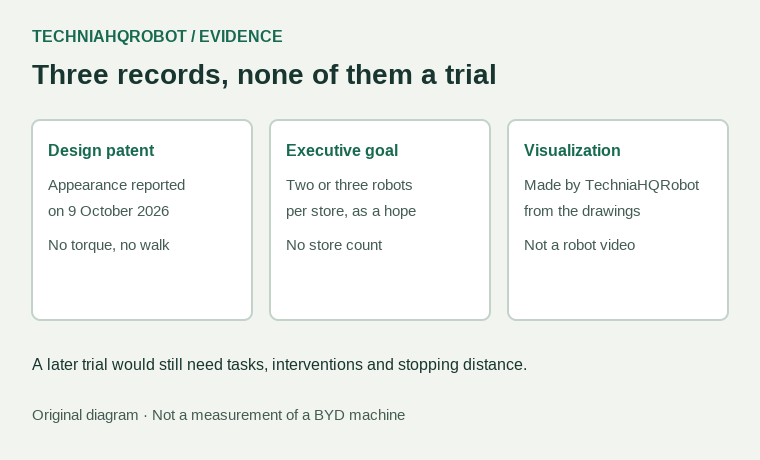
The 11 October 2026 post puts a humanoid in a BYD showroom story. Read slowly, it contains three objects: a design patent, an executive hope for stores, and a clip the account itself identifies as a visualization. None of the three is a robot opening a car door in a dealership. [2]
This clip is a 3D visualization of the design revealed in its new patent, created by TechniaHQRobot. BYD wants two or three humanoid robots in every dealership. This remains a goal for future deployment.
@techniahqrobot on X
What the reported filing shows
CnEVPost reported on 9 October 2026 that China’s National Intellectual Property Administration had published a design patent for an embodied-intelligence robot, with BYD named as holder. The article describes two arms, two legs, articulated fingers, an oval head with a dark face, light covers on the torso and limbs, joints at the shoulders, elbows, hips and knees, and exposed mechanism around the waist and legs. It also says BYD had not formally unveiled a product, and that a design publication is not a debut. [1]
A design patent is about appearance. The CnEVPost account does not supply a patent number, an actuator list, a controller, or a walking test, and this page did not retrieve the CNIPA gazette entry itself. Joints drawn at the shoulders and knees tell you the designer drew a body that bends there. They do not tell you the gear ratio, the torque, or whether a prototype with those covers exists. [1]
Two or three robots per store is a hope
The same report says executive vice president Stella Li, speaking in June, hoped eventually to place two or three robots in every BYD dealership to introduce vehicles and show them to customers. She is also reported as saying that robots cannot replace the connection between human sales staff and customers, and that dealerships could sell household robots later if that market arrived. She described manufacturing, software and hardware as the competitive ground, and an open platform that could include both BYD machines and partners’ machines. [1]
“Hoped eventually” is not a dated rollout, a budget, or a count of stores already equipped. A company with showrooms can host a trial more easily than a lab without customers. Hosting is not the same as having run one. The post agrees with that limit: it calls the store idea a goal for later deployment. [1] [2]
The clip is labeled as a visualization
The post says the video is a 3D visualization of the patent design, made by TechniaHQRobot. That is an illustration of published drawings, in the same family as a redraw. It can help a reader see fingers and limb joints. It cannot show balance, speech, door opening, or a safe stop near a customer. Anyone embedding the clip should keep that sentence next to it. [2]
What a store trial would have to record
If BYD later puts a robot on a showroom floor, the useful record is operational. Which tasks ran: greeting, a recited feature list, a door opening, a walk to a car. Who started the task, and how often a staff member took over. How close the robot came to customers, and what stopped it. Whether the car it touched was the car in that store or a prop. The patent report contains none of those fields. [1]
Autonomy is a per-task question, not a label on the body. Are humanoid robots autonomous?
BYD humanoid design patent: practical access and long-term support
Buying and current availability
A design patent does not establish a product that can be ordered. No verified purchase price or delivery route follows from the patent record.
Installation, software and updates
No public installer, SDK or owner firmware procedure is established by the patent.
If a supported release is available, record the hardware revision and current software, back up the documented configuration and calibration, check release notes and verify the same supported operation after upgrading. For a research prototype without an owner release, these steps remain a checklist, not an installation manual.
Battery, maintenance and lifetime
A design drawing does not establish pack capacity, runtime, charge cycles or maintenance intervals.
For a physical robot, record the actual task, duration, energy use, faults and replaced parts over repeated comparable tests. A product runtime does not give a pack cycle rating or whole robot lifetime. For a design-only publication, these quantities are not established.
Sources and verification
- BYD humanoid robot design emerges as formal debut remains pendingCnEVPost · Read 13 October 2026
News report of a design patent published by China’s National Intellectual Property Administration on 9 October 2026. No patent number is given. The CNIPA record itself was not retrieved in this pass.
- Post on a BYD patent visualization and dealership goalTechniaHQRobot on X · Read 13 October 2026
The post says the clip is a 3D visualization made by TechniaHQRobot from the patent design, not footage of a working BYD robot.
Evidence limits
- The CNIPA record and a patent number were not retrieved. The description follows CnEVPost’s account of that publication.
- No actuator count, mass or walking test is taken from the design patent.
- Figures such as 31 degrees of freedom, attached to BYD robots in other coverage, are a different claim and are not used here.
Article history
Added the distinction between the reported design patent, Stella Li’s dealership goal, and the visualization in the original post.