ORCA proves a velocity choice for agents that can take that velocity
Van den Berg, Guy, Lin and Manocha frame reciprocal collision avoidance for independent mobile robots that share a space and do not talk to each other. Each agent takes half the responsibility for a pairwise conflict. The permitted velocities form a half-plane, and the chosen velocity is the solution of a small linear program. The project page says the resulting motions are smooth, and that the method gives sufficient conditions for collision-free motion under that construction. [1]
The experiments match those assumptions. Hardware tests use iRobot Create differential-drive robots. Simulations include dense crowds, on the order of thousands of agents, with collision-free velocities computed for all of them in a few milliseconds. A later note on the same page mentions a 25,000-agent crowd visualization. The guarantee they claim is local collision-free motion for many robots in a cluttered workspace, for agents whose action is a velocity. [1]
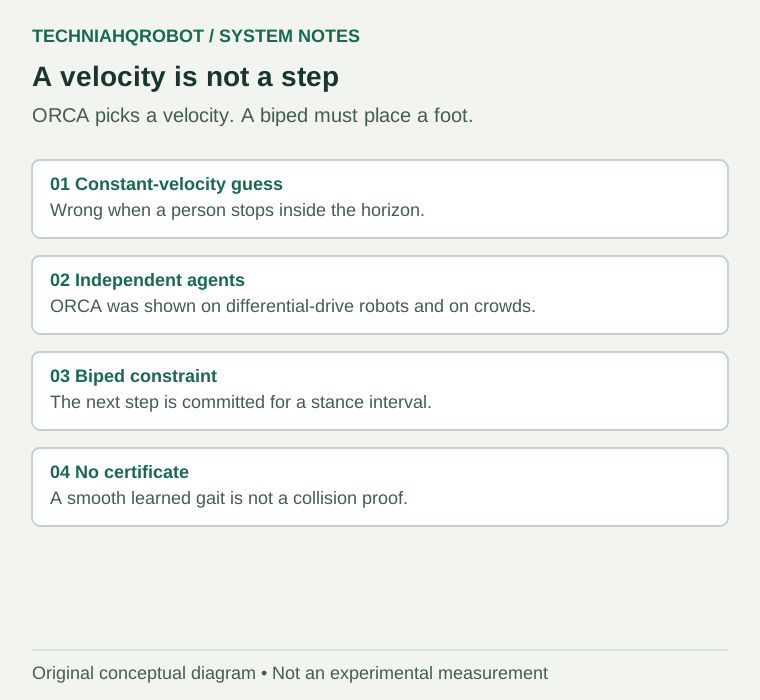
Read the action carefully. The optimization picks a velocity, and it assumes the agent can execute a velocity. A differential-drive robot can be commanded in that space, with the extra constraints handled in follow-on work from the same group. A biped is not in that action space. Its next action is a foot placement and a contact force, held for a stance interval. By the time the foot is down, the person may have stopped, turned, or sped up. The velocity that was collision-free at the start of the step is a statement about a body that cannot instantaneously become a different velocity. [1]
Constant-velocity forecasts fail inside one step
Reciprocal methods extrapolate the other agent’s current velocity across a time horizon. That is a good model when people in a crowd keep walking. It is a bad model when someone stops to read a label, steps backward, or lets a biped pass and then changes their mind. The half-plane was computed for the velocity that was seen. It is not a bound on acceleration of the person. The paper’s sufficient conditions do not include “the human may reverse inside the stance.” [1]
A geometric planner that only inflates the person by a radius has a related hole. The radius covers the body at the predicted place. It does not cover the body at the place the person can reach if they accelerate during the step. Making the radius larger is a hedge, not a detection of the new intent. It also blocks corridors that were actually free, which is why teams start trusting a tighter prediction. The tighter prediction is exactly the one a stop will violate. [1]
A learned gait can look smooth and still have no certificate
Reinforcement-learned walking can track a velocity command and step over uneven ground. Smoothness is also what the ORCA page claims for its linear program, on a different robot class. Smoothness is not a collision proof. ORCA at least states sufficient conditions inside its velocity model. A neural locomotion policy usually states a training setup and a set of demonstrated terrains. Neither one is a proof about a person who changes direction inside the step. [1]
Cadena’s SLAM survey makes a related point about representations. What the robot should remember is task-dependent. A sufficient statistic for “walk down an empty hall” is not a sufficient statistic for “a person may enter the next footstep.” A policy trained on geometric obstacles, or on people who keep a steady pace, has not been shown a reversal. Reporting average progress in a crowd that mostly walks forward does not measure the reversal. [2] [1]
Balance timing makes the missing certificate stricter. The Mini-Cheetah split, a joint loop at 40 kHz, a whole-body loop at 500 Hz, and an MPC at 30 Hz, shows that even a fast legged robot plans contacts slower than it servos them. A biped that needs a similar split cannot accept a brand-new avoidance velocity in the middle of stance just because a crowd algorithm could recompute one in a few milliseconds. The few milliseconds are the solve time for a velocity. They are not the time to place a foot and move the center of mass. [3] [1]
The rate split is argued on its own page. Balance-loop timingHere it only blocks a false transfer from ORCA’s solve time.
The stance interval is the horizon that matters
ORCA recomputes a velocity in a few milliseconds and can do so again on the next control tick of a mobile robot. A biped’s relevant horizon is the time until the swing foot can be placed somewhere else. During stance, the center of mass is already committed to a motion that the ground reaction forces can only shape within friction. A new velocity solved at millisecond scale cannot be applied until the mechanics allow a new contact. Treating the solve time as the reaction time imports a number from the wrong robot. [1] [3]
The person's change of mind fits inside that same interval. If stance lasts a few hundred milliseconds, a person who was walking at 1 m/s and stops has already broken the constant-velocity half-plane that was computed at heel strike. The sufficient conditions on the ORCA page are conditions about velocities that remain in the allowed set. They are not conditions about a human acceleration bound. A biped controller that wants a similar theorem has to write the theorem for footsteps and for a person who may stop. Copying the mobile-robot theorem does not write it. [1]
Learned locomotion does not close the hole by being trained on more walking. If the training disturbances are pushes of the torso, or blocks on the ground, the policy can be competent at those disturbances and still have no measured behavior for a person who enters the swing path. The trial row that matches the hole is small and specific: the person is on a collision course, then stops or reverses after the swing has started. Success on a forward-walking crowd does not fill that row. [1] [2]
Protective separation, discussed on the latency page, is the layer that does not need the gait to be a proof. Its inputs are reaction time, stop time, and uncertainty. A biped that can execute a validated stop from the speed it is actually walking can use that stop when the person violates the forecast. A biped that can only modulate a gait reward cannot point at ORCA, or at a training curve, and call the result a safety case. [4] [1]
What would count as evidence, and what does not
A smooth walk past a person in a video is not a reversal test. A reversal test states the person's speed, the instant they stop or turn, the robot's speed, the step phase at that instant, and whether the next foot lands clear. It also states the protective layer that is independent of the gait: a scanner, a rated stop, or a separation distance computed with a real stopping time. Without that layer, a successful clip is a sample, not a bound.
- ORCA's original evidence is a local velocity proof under constant-velocity assumptions, plus hardware on wheeled robots and a fast simulation of many agents. It is not a biped footstep proof.
- A geometric planner that assumes a static person fails at the moment the person moves. Updating the map does not create a contact model.
- A learned gait that survives pushes in training has not been shown to reverse a committed step unless that reversal is in the test.
- Solve time in milliseconds is not the horizon of a stance. Report both, separately.
- Do not describe the result as fully safe. Describe the layer that still works when the prediction is wrong.
The practical conclusion is narrow. Use prediction to place the next candidate step. Keep a short-horizon geometric check on that step. Keep a protective stop whose distance does not depend on either one. The three clocks are different, and only the last one is a safety argument.
What a biped team can claim without borrowing a mobile-robot proof
| Claim | Where it was shown | Why a biped does not inherit it |
|---|---|---|
| Collision-free velocity in a few milliseconds | ORCA simulations of thousands of agents, and iRobot Create robots. | The action is a velocity. A step is a contact interval. |
| Each agent takes half the responsibility | Independent robots, no communication. | A person is not obliged to take half, and may stop. |
| Smooth motion | Stated for the ORCA velocity solution. | Smooth walking is not a bound on a reversal during stance. |
| Local guarantee | Under the paper’s velocity-obstacle conditions. | Those conditions are not a humanoid balance certificate. |
- Report people who stop or reverse as their own trial row. Do not average them into a crowd that walks forward.
- State the step duration and whether the avoidance command can change the foot already in the air.
- Keep a protective separation function if people can touch the machine. A gait reward is not that function.
- Do not cite ORCA’s millisecond solve, or its local guarantee, as a humanoid safety case.
The design that survives this reading is modest. Use a geometric or learned policy to propose footsteps in free space. Assume the person can violate the constant-velocity guess. Give the balance loops a reference they can track at their own rate. Put a measured stop, with its own sensor, between the body and the person when the layout requires it. None of those sentences says the walk is safe. They say which proofs you do not have. [1] [3] [4]
Sources and verification
- Optimal Reciprocal Collision Avoidance ↗Jur van den Berg, Stephen J. Guy, Ming Lin and Dinesh Manocha · Read 12 October 2026
Project page for the ISRR 2011 reciprocal collision-avoidance method. Independent agents, no communication, a linear program on velocity. Hardware example is iRobot Create differential-drive robots. Thousands of simulated agents, a few milliseconds. Not a biped balance proof.
- Past, Present, and Future of Simultaneous Localization and Mapping ↗César Cadena and colleagues, IEEE Transactions on Robotics · Read 12 October 2026
Author manuscript on arXiv, later IEEE TRO 2016, 32(6):1309–1332. Used for dynamic scenes, long-term map change, semantic fusion, and the unmet need for high-rate estimation. No warehouse failure rate is taken from this survey.
- Dynamic quadruped locomotion via whole-body impulse control and model predictive control ↗Donghyun Kim and colleagues · Read 12 October 2026
Mini-Cheetah measurements in the paper: joint PD at 40 kHz, whole-body impulse control at 500 Hz, MPC at 30 Hz. These are quadruped rates, not a humanoid trial.
- Implementing Speed and Separation Monitoring in Collaborative Robot Workcells ↗Jeremy Marvel and colleagues, NIST, Robotics and Computer-Integrated Manufacturing · Read 12 October 2026
Public account of the ISO/TS 15066 protective-separation formula. Human motion during reaction plus stop, robot motion during reaction, stopping distance, intrusion, and position uncertainty. Stopping time depends on speed and load.
Evidence limits
- ORCA’s hardware robots are iRobot Create platforms, not bipeds.
- The local collision-free conditions assume the velocity action the paper optimizes.
- No humanoid trial in these sources shows a person reversing inside a step.
Article history
Added ORCA’s published assumptions and hardware, and the reasons a biped step does not inherit that velocity proof.
Report a correction